SEO & Lead Generation
  Google Adwords Management
 Social Media Management
 Ecommerce Marketing
 WordPress & Shopify Services
 Website & App Designing
  Website Speed Optimization
  Website Hosting Services
  Amazon PPC Marketing
  Landing Page Designing
 Logo Designing Services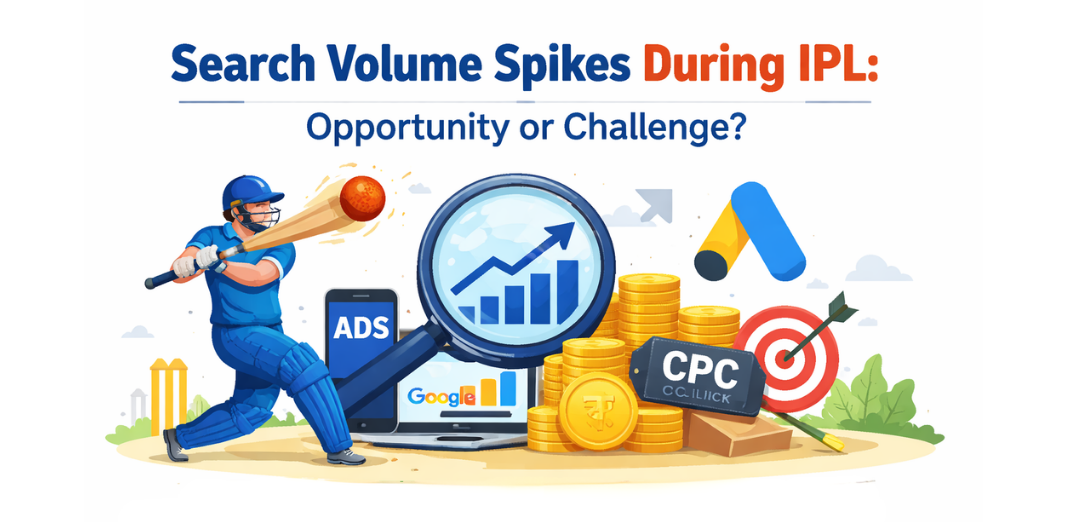

 ×
×

Every year, as the Indian Premier League (IPL) begins, India experiences a massive digital shift. Millions of users go online—not just to watch matches, but to search, shop, order food, and engage with brands.
For advertisers, especially those running Google Ads campaigns, this period brings a critical question:
👉 Is the IPL search volume spike an opportunity… or a challenge?
The answer is: both.
In this blog, we’ll break down how IPL affects search behavior, Google Ads performance, and what strategies you should adopt to stay profitable.
Let’s break it down.
During IPL, user behaviour changes significantly as audiences become highly engaged with matches, teams, and real-time updates. This shift naturally drives an increase in search activity across multiple categories.
Firstly, IPL creates a massive surge in cricket-related searches such as live scores, match schedules, team stats, and player updates. Millions of users are actively searching during match hours, which increases overall search traffic across Google.
Secondly, IPL also influences lifestyle and consumption patterns. People tend to order food, shop online, stream content, and engage with entertainment platforms during matches. This behaviour increases search demand in industries like food delivery, e-commerce, OTT platforms, and gaming.
Additionally, brands heavily invest in advertising during IPL, which increases awareness and drives users to search for products and services they see in ads. This results in indirect search volume growth even in non-cricket-related industries.
Another major factor is second-screen behaviour. While watching matches on TV or mobile, users simultaneously browse Google for offers, products, and services, which leads to spikes in search queries during match timings.
Overall, IPL creates a digital ecosystem where user attention is high, engagement is intense, and search activity increases across multiple sectors.
For advertisers who understand the IPL ecosystem, this period can be extremely profitable.
One of the biggest advantages is the increase in search demand. Higher search volume means more opportunities to capture traffic, especially for high-intent keywords. Businesses that align their campaigns with trending searches can experience a significant boost in impressions and clicks.
Another key opportunity lies in consumer intent. While entertainment is the primary focus, users are still actively searching for solutions, products, and services. If your ads are relevant and well-targeted, you can capture users at the right moment and drive conversions.
IPL also provides a great chance for brand visibility. With more people online, your ads can reach a wider audience. Even if users do not convert immediately, repeated exposure helps build brand recall, which can lead to conversions later.
Moreover, advertisers who use IPL-themed creatives or messaging can stand out from competitors. By aligning ad copy with cricket-related emotions and excitement, brands can improve click-through rates and engagement.
In short, IPL offers a high-traffic environment where smart advertisers can scale campaigns, increase visibility, and generate more leads.
While the opportunities are significant, IPL also brings several challenges that advertisers must be aware of.
One of the biggest issues is increased competition. Since many brands increase their ad spend during IPL, the competition for keywords rises sharply. This leads to higher cost-per-click (CPC), making it more expensive to acquire traffic.
Another challenge is fluctuating user intent. During match hours, users may be more focused on entertainment rather than making purchase decisions. This can lead to lower conversion rates, even if traffic increases.
Additionally, ad performance can become unpredictable. Campaigns that perform well during non-IPL periods may experience a drop in conversions due to changes in user behaviour and attention span.
Budget wastage is another common problem. Without proper optimisation, advertisers may end up spending more without seeing proportional returns, especially if they do not adjust bidding strategies or targeting.
Lastly, timing plays a crucial role. Ads running during peak match hours may get clicks but fewer conversions, while non-match hours may perform better in terms of ROI.
IPL doesn’t just increase search volume—it directly affects key Google Ads metrics.
CPC tends to increase due to higher competition among advertisers bidding for the same keywords. This can significantly impact campaign profitability if not managed properly.
CTR (Click-Through Rate) may improve if your ad creatives are relevant and engaging, especially if they align with IPL trends. However, generic ads may struggle to attract attention during this high-noise period.
Conversion rates can either increase or decrease depending on your industry and timing. For example, food delivery services may see higher conversions during match time, while B2B services may experience a decline.
Impression share also becomes more competitive, meaning advertisers may need to increase bids or budgets to maintain visibility.
Understanding these metric shifts is crucial to making informed decisions during IPL.
To make the most of IPL traffic, advertisers need to adapt their strategy rather than relying on standard campaign setups.
Start by adjusting your ad scheduling. Analyse when your target audience is most likely to convert and allocate budget accordingly. In many cases, non-match hours or breaks between matches may deliver better results.
Next, focus on intent-based keywords. Instead of targeting broad or generic terms, prioritise high-intent keywords that are more likely to convert.
It is also important to optimise your bidding strategy. Consider using smart bidding strategies like Target CPA or Maximise Conversions, but monitor them closely to ensure they adapt well to IPL trends.
Ad creatives should also be updated to reflect IPL themes. Adding cricket-related messaging can make your ads more relatable and improve engagement.
Additionally, ensure your landing pages are optimised for speed and mobile experience, as a large portion of IPL traffic comes from mobile users.
Finally, keep a close eye on performance data. IPL is a dynamic period, and continuous optimisation is key to maintaining profitability.
IPL is neither purely an opportunity nor entirely a challenge—it is a dynamic environment that requires strategic decision-making.
If you approach IPL with a static strategy, it can quickly become a costly challenge due to increased competition and changing user behaviour.
However, if you adapt your campaigns, monitor performance closely, and align your strategy with IPL trends, it becomes a powerful opportunity to scale your business.
The key lies in understanding your audience, choosing the right timing, and continuously optimising your campaigns.
Search volume spikes during IPL are a double-edged sword. They bring massive traffic and visibility but also increased competition and unpredictability.
For advertisers using Google Ads, the goal should not be to avoid IPL but to leverage it intelligently.
Those who adapt quickly, optimise consistently, and align their campaigns with user behaviour will not only survive the IPL season but thrive in it.

I am a performance-driven Google Ads and Meta Ads Specialist with over 1 year of hands-on experience, currently working at Kleverish Digital Marketing Agency. I specialize in planning, executing, and optimizing data-driven advertising campaigns that deliver measurable results.



 Rated 4.99/5 overall
across 100+ reviews
Rated 4.99/5 overall
across 100+ reviews