SEO & Lead Generation
  Google Adwords Management
 Social Media Management
 Ecommerce Marketing
 WordPress & Shopify Services
 Website & App Designing
  Website Speed Optimization
  Website Hosting Services
  Amazon PPC Marketing
  Landing Page Designing
 Logo Designing Services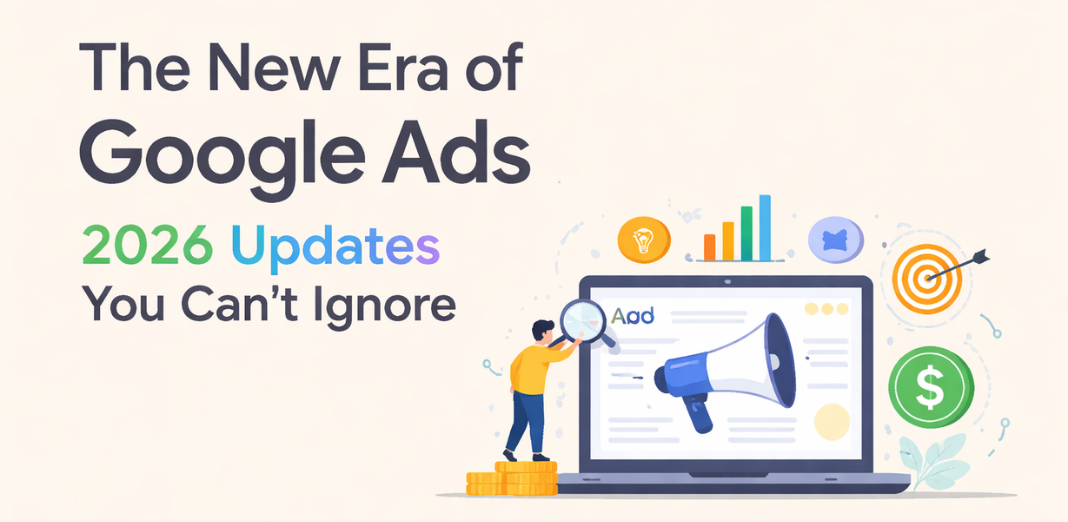

 ×
×

Google Ads isn’t just evolving—it’s completely redefining how digital advertising works in 2026. The platform is moving away from manual control and stepping deeper into AI-powered decision-making, where automation, audience signals, and creative assets matter more than ever before.
What used to work even a year ago may no longer deliver the same results today. From major updates in Performance Max to changes in attribution and Shopping experiences, Google is clearly shifting the focus toward smarter, more predictive advertising.
In this blog, we’ll explore the most important updates and what they actually mean for your campaigns, so you can stay ahead instead of playing catch-up.
Google has started refining and restructuring its legacy ad formats. These updates are designed to align older ad formats with modern AI-driven campaign structures. Instead of relying on outdated formats, advertisers are encouraged to adopt responsive and automated ad types that adapt across multiple placements.
This shift highlights Google’s long-term vision: simplifying ad creation while improving performance. Advertisers who still depend on older formats may notice reduced efficiency or limited reach over time. Transitioning to responsive search ads and automated formats is no longer optional—it’s essential.
A significant update for automotive businesses is the introduction of vehicle feeds directly within Search campaigns. This allows advertisers to showcase inventory in a more dynamic and structured way.
Instead of static ads, users can now see detailed vehicle listings including images, pricing, and specifications. This improves both user experience and conversion rates because users are getting more relevant information before clicking.
For advertisers, this means better-qualified leads and improved ROI, especially in competitive markets like car sales.
One of the most impactful updates is the comparison between 30-day and 1-day attribution windows. Google is emphasizing shorter attribution windows for more accurate and real-time performance tracking.
A 1-day attribution model provides immediate insights into user behavior, which is particularly useful for fast-moving campaigns. On the other hand, a 30-day model still holds value for industries with longer decision-making cycles.
The key takeaway here is flexibility. Advertisers should test both models and align attribution windows with their business type. For example, e-commerce brands may benefit from shorter windows, while education or real estate campaigns may still require longer tracking periods.
Google is experimenting with sticky banner ads on YouTube, which remain visible even after the main video ad ends. This increases visibility and creates additional touchpoints for users.
This update is particularly powerful for brand recall and retargeting strategies. Instead of a one-time impression, advertisers now get extended visibility, improving engagement and click-through rates.
For marketers, this opens new opportunities to combine video storytelling with persistent display elements, creating a stronger overall campaign impact.
Performance Max campaigns are becoming more transparent with improved video visibility reporting. Previously, advertisers had limited insight into how video assets performed within PMax.
Now, advertisers can better understand how video contributes to conversions and engagement. This allows for more informed creative optimization.
This update reinforces the importance of video content in modern advertising. Businesses that invest in high-quality video assets will likely see better performance across multiple placements.
Another enhancement in Performance Max is the deeper integration of video performance metrics. Advertisers can now analyze impressions, engagement, and conversion contributions from video assets more clearly.
This update encourages advertisers to think beyond static creatives. Video is no longer optional—it’s a core part of a successful campaign strategy.
With better reporting, marketers can refine their creatives based on actual data rather than assumptions.
Google has clarified that certain AI-driven experiences will remain ad-free, particularly those focused on personal intelligence and assistance.
This indicates a shift in how Google balances user experience with monetization. While ads remain central to Google’s business, not every AI interaction will include advertising.
For advertisers, this means fewer interruptions but more meaningful placements. Ads will likely appear in high-intent environments rather than everywhere.
The latest version of Google Ads Editor introduces more advanced creative control and campaign management features.
Advertisers can now make bulk edits more efficiently, manage assets better, and gain more control over campaign structures. This is especially useful for agencies and large-scale advertisers managing multiple accounts.
This update improves workflow efficiency and reduces the time required for campaign optimization.
Google is testing a new Shopping feature called “Sponsored Shops,” which highlights brands directly within search results.
This is a major opportunity for e-commerce businesses. Instead of promoting individual products, brands can now showcase their entire store experience.
This shift moves Shopping ads closer to a marketplace model, where brand presence becomes just as important as product listings.
The biggest takeaway from all these updates is clear—Google Ads is moving beyond keywords. AI and automation are now at the center of campaign success.
Instead of focusing only on keyword targeting, advertisers must now prioritize audience signals, creative quality, and data inputs. Performance Max campaigns, AI bidding, and automation tools are designed to handle complexity, allowing marketers to focus on strategy.
This doesn’t mean keywords are irrelevant, but their role is evolving. Success now depends on how well you guide AI with the right data and creatives.
Google Ads in 2026 is smarter, more automated, and more data-driven than ever before. These updates clearly show that Google is pushing advertisers toward AI-powered campaigns, better attribution models, and enhanced creative strategies.
To stay competitive, businesses must adapt quickly. This means embracing automation, investing in high-quality creatives, and continuously testing new features.
Those who evolve with these changes will see better performance, higher ROI, and stronger campaign scalability.

I am a performance-driven Google Ads and Meta Ads Specialist with over 1 year of hands-on experience, currently working at Kleverish Digital Marketing Agency. I specialize in planning, executing, and optimizing data-driven advertising campaigns that deliver measurable results.



 Rated 4.99/5 overall
across 100+ reviews
Rated 4.99/5 overall
across 100+ reviews