SEO & Lead Generation
 Google Adwords Management
 Social Media Management
 Ecommerce Marketing
 WordPress & Shopify Services
 Website & App Designing
 Website Speed Optimization
 Website Hosting Services
 Amazon PPC Marketing
 Landing Page Designing
 Logo Designing Services

 ×

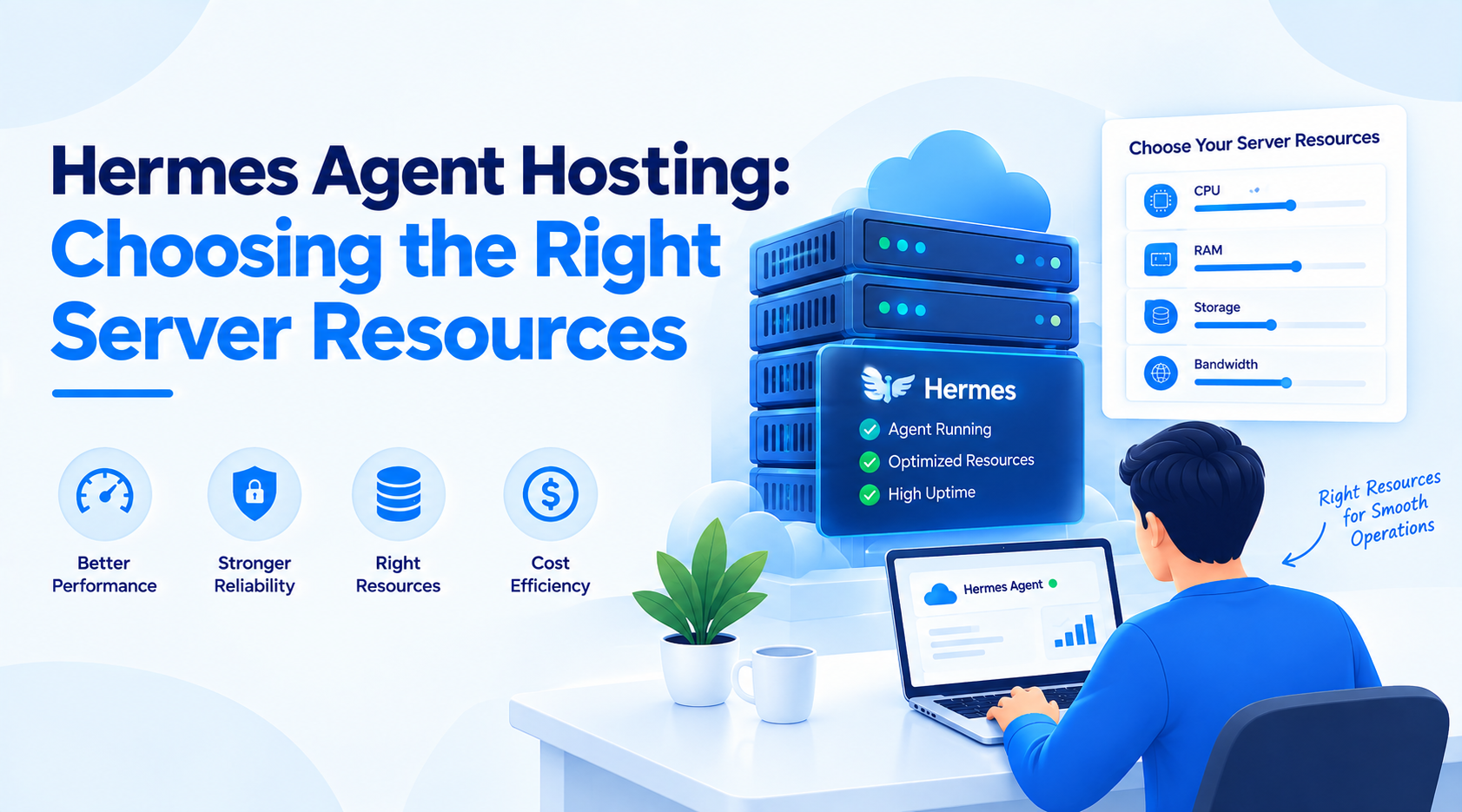
Running an AI agent is nothing similar to hosting a normal website. Every request triggers reasoning, memory lookups, and often several model calls at once. Choosing resources for Hermes agent hosting starts with understanding this difference clearly, well before you compare pricing plans. A server built for static pages will buckle under constant computation. Your infrastructure needs to match how the agent actually behaves, not the checklist you’d use for a regular website.
Most teams stumble at the very first step, picking hosting meant for websites instead of intelligent systems. VPS hosting for AI agents provides dedicated processing power, predictable memory, and root access to tune the environment precisely to a specific workload. This matters more as your agent takes on complex tasks, larger context windows, and concurrent users. With the right foundation in place, slowdowns rarely show up at all, even during the busiest hours.
Every Hermes agent handles a distinct set of tasks: parsing input, running model inference, storing context, and returning a response. These stages pull resources in different directions, and treating them as one single load leads to poor planning. Inference relies heavily on CPU and RAM. Memory storage, meanwhile, depends on rapid, reliable disk access throughout the session, and skipping this part of the equation shows up later as slow replies during peak hours.
Outline the details before selecting a plan. Paying for capacity nobody touches is one problem. Running short of capacity precisely when traffic spikes is the more costly problem. A clear picture of where the agent actually spends its cycles turns hosting into a calculated decision instead of a guess. Teams that do this analysis early rarely deal with surprise bills or downtime once people start relying on the agent daily.
An agent’s workload breaks down into a handful of categories, each pulling on server resources differently:
Infrastructure research has found that agent workloads often consume nearly three times the memory of a comparable web application. That single number explains why a generic hosting plan works fine for a demo and falls apart the moment real users show up.
CPU cores decide how many requests your agent handles at once without one waiting behind another. A Hermes agent handling several conversations needs dedicated cores, not a fraction shared with neighboring accounts on an overloaded server. RAM is equally important, as every open session retains its context in memory, and a tight allocation quickly turns into dropped or delayed replies once traffic picks up.
Four to eight gigabytes is usually fine for lighter agents built around short exchanges. For longer context windows and more complex reasoning chains, sixteen gigabytes or more is a safer choice. It’s worth testing with realistic conversation lengths rather than quick sample prompts, since that shows more clearly what the agent needs before it goes live.
Disk speed decides how fast an agent pulls stored context, embeddings, and logs mid-conversation. NVMe storage reduces the lookup delay that would otherwise show up as lag, and users notice it within seconds, not minutes. Bandwidth needs the same attention, especially for agents calling external APIs constantly or handling many users at once without any drop in quality.
This is where MilesWeb fits in. Their VPS plans combine NVMe storage with unmetered bandwidth on the higher tiers, giving a Hermes deployment room to absorb a sudden spike instead of buckling under the strain. That matters once the agent is fielding real client conversations rather than internal tests, and it saves you from guessing at monthly data transfer before launch.
Traffic tends to shift constantly. Agents that work well tend to pull in more users as word spreads and trust builds. Vertical scaling, adding CPU or RAM on the same server, handles early growth just fine when demand climbs slowly. Once demand gets heavier and arrives from several directions at once, horizontal scaling, spreading the load across multiple instances behind a balancer, tends to hold up better.
Pick a host that supports both routes from day one. Doing this early saves you from a difficult migration down the line, after the agent already carries real conversations people depend on. Smooth growth builds confidence in the product. Uneven growth erodes it fast. A short checklist keeps the decision honest:
Hermes agents respond better to careful planning than to sheer processing power alone. Matching CPU, RAM, storage, and bandwidth to what the agent actually does keeps things steady as demand builds month over month. MilesWeb supports this well in practice, since its VPS plans come with free professional email accounts and daily backups built in, small things that save real time as the project grows.
Set the system up with care now, and the agent will handle whatever comes its way with room to spare. Solid infrastructure rarely draws attention to itself. It continues to perform its duties, one conversation at a time, precisely when it is most needed.

Pinal Bhalodia is a multi-faceted professional with a diverse skill set spanning creative website design, Google Adwords, Search Engine Optimzation , IT expertise, and sales acumen. With a passion for blending technology with artistic flair, Pinal has carved a niche for himself in the dynamic intersection of these fields.


 Rated 4.99/5 overall
across 100+ reviews