SEO & Lead Generation
  Google Adwords Management
 Social Media Management
 Ecommerce Marketing
 WordPress & Shopify Services
 Website & App Designing
  Website Speed Optimization
  Website Hosting Services
  Amazon PPC Marketing
  Landing Page Designing
 Logo Designing Services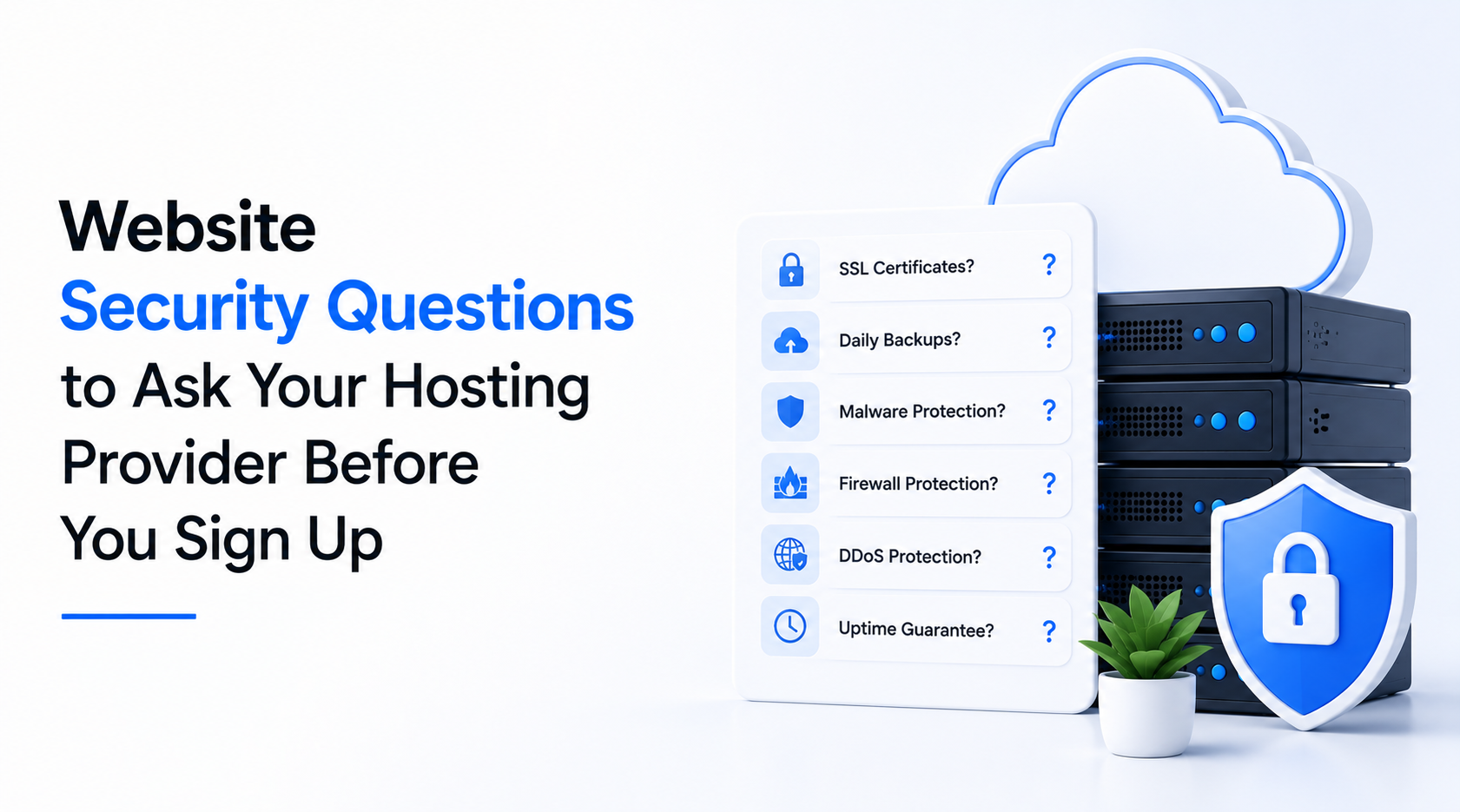

 ×
×

Choosing a hosting provider is not just about the speed and price. Security is one of the most critical factors, especially when you are building a website for your business. If you are using an Indian AI website builder to design and launch your site, the hosting environment underneath it determines how protected your data, visitors, and business reputation actually are. Many users pick a plan without asking the right questions, and they only discover security gaps after a breach or downtime. This blog covers the questions you must ask before signing any contract.
When your website runs on Python shared hosting, the security conversation becomes even more specific. Python applications often involve databases, APIs, and user authentication, so weak hosting security puts more than just your homepage at risk. According to a report by Verizon, 74% of data breaches involve a human element, which is often traced to the hosting environment. Asking your provider about isolation between accounts, server hardening, and software patching is not optional. It is the foundation of a secure site.
SSL certificates encrypt the connection between your website and its visitors. Most reputable providers now offer free SSL through Let’s Encrypt or similar certificate authorities.
However, you should also ask how often the certificate renews, whether it renews automatically, and whether the provider monitors expiry. A lapsed SSL certificate will trigger browser warnings that drive visitors away and hurt your search rankings.
A web application firewall (WAF) filters malicious traffic before it reaches your site. It blocks known attack patterns, such as SQL injection and cross-site scripting. Ask your provider whether a WAF is included, which ruleset it uses, and how frequently it updates.
DDoS attacks have become more common and more powerful. According to Cloudflare’s 2024 DDoS Threat Report, hyper-volumetric attacks exceeding 1 Tbps have increased significantly in frequency. Your hosting provider should have infrastructure-level DDoS mitigation in place, not just software-level filters. If they cannot describe their mitigation strategy, that is a red flag.
Backups are your last line of defense when everything else fails. Ask whether the provider takes automated daily backups or only weekly ones. Find out where those backups are stored, whether they are stored off-site, and whether you can restore from a backup yourself or need to raise a support ticket.
Many cheap hosting plans advertise backups but store them on the same server, which means a hardware failure wipes both your site and its backup simultaneously. A reliable provider will maintain at least seven days of rolling backups stored in a separate location. They will let you test a backup restore without any additional charges.
This question is especially important if you are on a Python shared hosting plan or using an Indian AI website builder platform that hosts thousands of accounts on shared infrastructure.
Ask your provider whether they use container-based isolation, and whether they deploy tools like CageFS or similar technologies that keep each account in its own restricted environment.
Malware scanning should run automatically, not only when you request it. Ask whether the provider includes server-side malware scanning and how frequently it runs. Do they actively quarantine infected files, or only send notifications and expect you to handle the cleanup?
According to Sucuri’s Website Threat Research Report, CMS platforms such as WordPress accounted for 96.2% of the infected websites they remediated. Shared hosting environments are particularly at risk because outdated plugins and themes across multiple accounts create a broad attack surface. A proactive scanning policy from your host adds a layer of protection that complements your own site-level security practices.
Unpatched server software is one of the most common entry points for attackers. Ask your provider which version of PHP, Python, and other server-side languages they support, how quickly they apply security patches, and whether you can force an update or are dependent on their maintenance schedule.
If you are running applications on Python shared hosting, version compatibility matters. Older Python versions may not receive security updates from the Python Software Foundation. A hosting provider that works in outdated environments and does not offer a clear patching timeline is a liability for any website that handles user data.
Your hosting control panel is the master key to your entire website. Two-factor authentication on the control panel adds a significant barrier, even if your password is compromised.
Ask your provider whether two-factor authentication is available and whether they are enforced by default. Also, ask whether they log control panel access by IP, and whether they provide alerts for unusual login activity. These features cost providers very little to implement, but their absence is a meaningful security gap.
Security should be a conversation, not an afterthought. Whether you are launching your first site through an Indian AI website builder or deploying a complex application on Python shared hosting, the questions above will tell you a great deal about how seriously your provider takes protection. A provider that gives vague or dismissive answers to these questions is one worth walking away from before signing up.

Pinal Bhalodia is a multi-faceted professional with a diverse skill set spanning creative website design, Google Adwords, Search Engine Optimzation , IT expertise, and sales acumen. With a passion for blending technology with artistic flair, Pinal has carved a niche for himself in the dynamic intersection of these fields.



 Rated 4.99/5 overall
across 100+ reviews
Rated 4.99/5 overall
across 100+ reviews