SEO & Lead Generation
  Google Adwords Management
 Social Media Management
 Ecommerce Marketing
 WordPress & Shopify Services
 Website & App Designing
  Website Speed Optimization
  Website Hosting Services
  Amazon PPC Marketing
  Landing Page Designing
 Logo Designing Services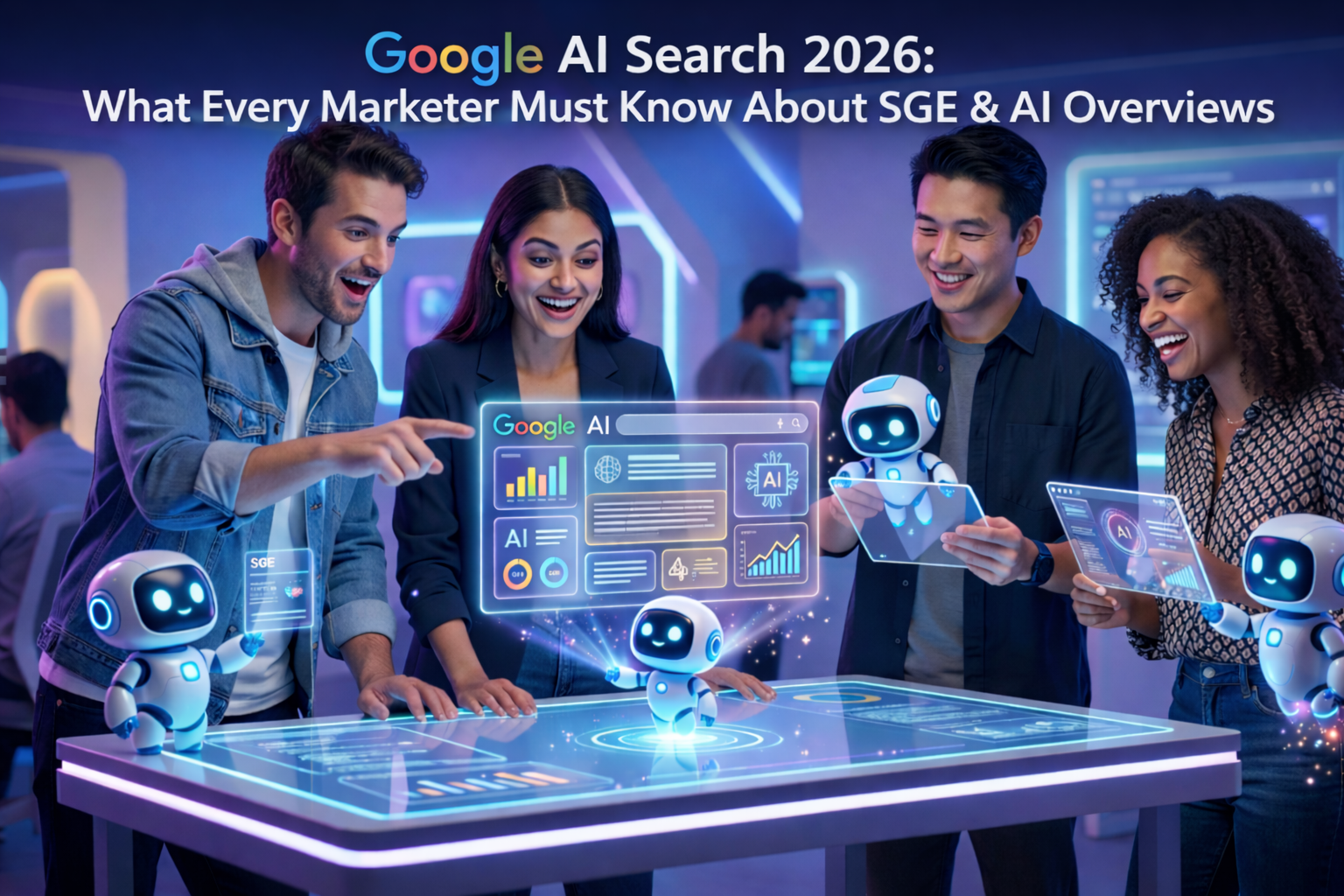

 ×
×

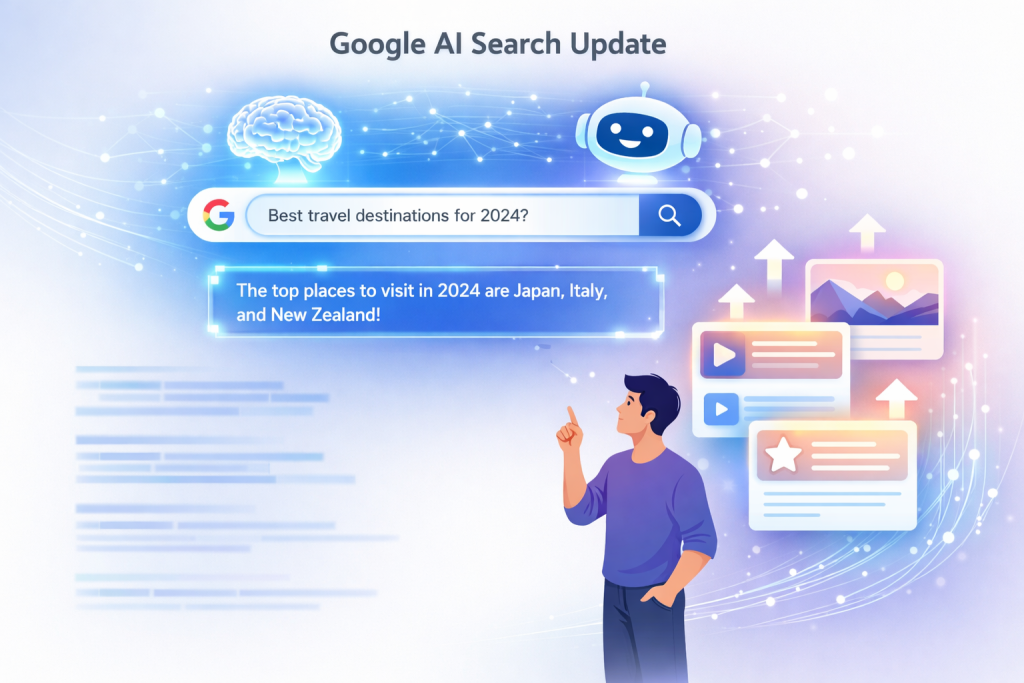
Let’s start simple. Google SGE stands for Search Generative Experience. It is Google’s way of using Artificial Intelligence to directly answer your questions right on the search results page — before you even click on any website.
Think of it like this: earlier, when you searched best SEO company in India, Google would show you a list of 10 websites. Now, with google ai search 2026, Google itself writes a mini-answer at the top using AI. This answer box is called an AI Overview.
This is the biggest change to Google search in 25 years. And if you are a business owner, blogger, or digital marketer — this affects you directly.
Key numbers to know:
Imagine you have a very smart friend who has read every website on the internet. When you ask him a question, he doesn’t hand you a pile of books. He simply tells you the answer in his own words — and then shows you the books he learned from, just in case you want more details.
That is exactly what Google Search Generative Experience (SGE) does. Here is the step-by-step of how it works:
“We’re moving from a search engine to an answer engine — and the brands that understand this shift early will win the next decade of organic visibility.”
The key point for marketers: your website may rank #1 on Google, but if the AI Overview answers the user’s question completely, they may never even click your link. This is the core impact of AI search on website traffic in 2026.
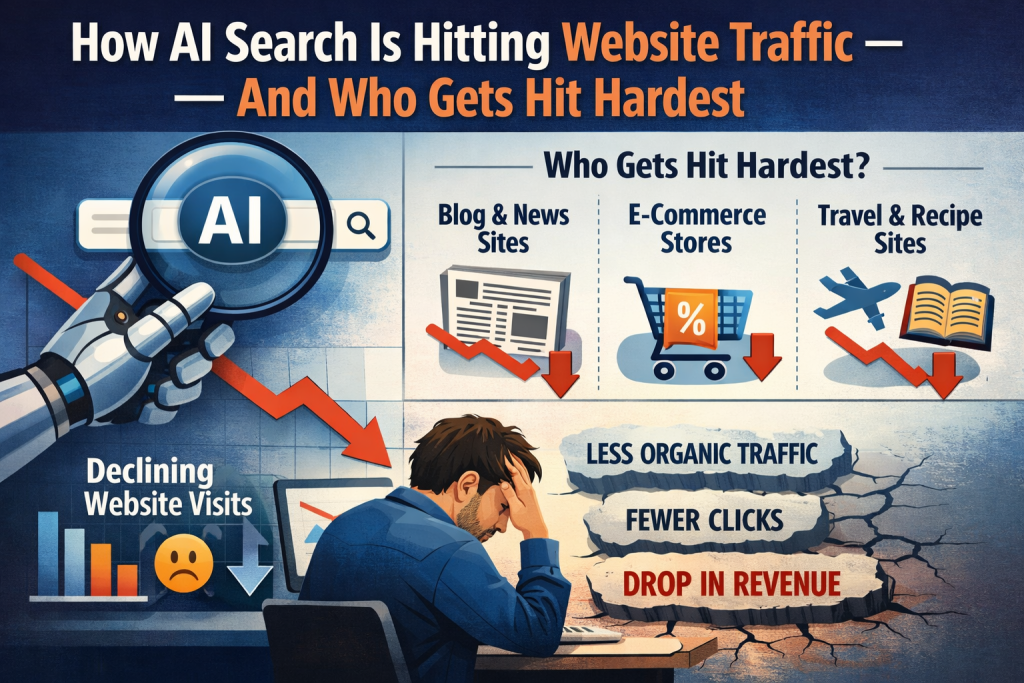
The impact of AI search on website traffic is real and it is being felt across industries. But not everyone is affected equally.
| Content Type | Traffic Impact | Risk Level |
| Definition articles (“What is…”) | 40–70% drop | High |
| How-to guides (basic level) | 30–50% drop | High |
| Comparison articles | 20–35% drop | Medium |
| Product reviews (E-E-A-T based) | Minimal impact | Low |
| Local business pages | Slight increase | Opportunity |
| Long-form expert analysis | Often cited as source | Opportunity |
| News & current events | Varies widely | Medium |
The websites most affected are those that were built around re-packaging facts that anyone can find. If Google’s AI can summarise your content in 3 sentences, your 1,500-word article loses its reason to exist in the old model.
However, businesses that publish original research, personal experiences, expert opinions, and local knowledge are seeing their content get cited inside AI Overviews — which can actually bring them visibility they never had before.
Here is the good news: SEO is not dead. It has evolved. The rules have changed, but the game is still very much playable. Here is what a solid sge seo strategy looks like in 2026:
Google’s AI only cites content it trusts. If your content is generic, it will not be cited. Add author bios, real case studies, data from your own work, and first-person experience. Show Google you are a real expert — not a content farm.
The future of seo 2026 is about questions, not just keywords. People now ask Google full questions like “which is the best SEO company in India for small businesses?” Target these naturally in your content.
Instead of writing 10 shallow articles on 10 topics, write 3 deeply researched pillar articles. Cover a topic end-to-end. Google’s AI prefers citing comprehensive sources over surface-level content.
AI Overviews mostly appear for informational searches. They appear much less for transactional searches like “hire SEO company India” or “buy X product online.” Push more energy into conversion-focused content that drives real business results.
Local SEO has become more powerful in the AI era. When someone searches “SEO agency near me” or “digital marketing services in Ahmedabad,” Google’s AI still relies heavily on Google Business Profile data. Keep your GBP updated, collect reviews, and use local keywords naturally.
When people search for your brand by name, Google’s AI is less likely to interfere. Invest in brand building — social media, PR, podcast appearances, YouTube — so people search for you directly, bypassing the AI battle altogether.
✓ Add schema markup (FAQ, Article, HowTo) to all key pages
✓ Write at least one 2,000+ word pillar post per core topic
✓ Add a real author bio with credentials to every article
✓ Claim and fully optimise your Google Business Profile
✓ Get your brand mentioned on at least 3 authoritative industry sites
✓ Audit and remove thin, low-value content from your website
✓ Start building an email list — your Google-independent traffic source
The ai search google update didn’t happen overnight. It started as an experiment in 2023 and by 2025–2026 became the default experience globally — including India.
| Year | What Happened |
| 2023 | Google launched SGE as an opt-in experiment in Google Labs (USA) |
| Early 2024 | AI Overviews rolled out to US users without opt-in requirement |
| Mid 2024 | Major global rollout; marketers noticed significant traffic changes |
| 2025 | AI Overviews expanded to India & most major markets; Gemini integration deepened |
| 2026 | AI Overviews now appear on nearly half of all search queries; SGE SEO strategy becomes mainstream |
this is not a temporary trend. This is the permanent new reality of search. Businesses that adapt now will have a massive competitive advantage over those who wait.
| Old SEO (Pre-SGE) | New SEO (SGE Era) |
| Keyword stuffing & thin content | Deep, expert-led, original content |
| Rank #1 for one keyword | Be cited in AI Overviews across many queries |
| Focus on clicks | Focus on impressions + brand recognition |
| Backlinks from directories | Mentions in authoritative publications |
| Meta description tricks | Structured data & schema markup |
| 100 mediocre blog posts | 10 outstanding pillar resources |
Indian businesses and marketers face a unique situation. Here is what makes the Indian google sge landscape different:
Working with an experienced SEO company in India that understands local nuances — from regional language content to Google Business Profile optimisation — can make a significant difference in how your brand adapts to the AI search era.
Reading about SGE is good. Taking action is what separates growing businesses from stagnant ones. Here are 3 concrete steps you can take right now:
Step 1 — Audit your top 10 pages Search Google for your main keywords. Do AI Overviews appear? If yes, is your site cited? This tells you exactly where you stand.
Step 2 — Add FAQ schema to 3 pages Pick your 3 most important pages and add FAQ schema markup. This increases the chance of Google’s AI pulling from your content as a trusted source.
Step 3 — Update your best article Take your single most-visited blog post. Make it 30% more detailed, add an author bio, add a FAQ section, and update the publish date. Watch what happens in 4–6 weeks.
Let’s be honest — google ai search 2026 is scary for a lot of website owners. Seeing traffic drop without knowing why is frustrating. But here is the thing: every major shift in Google search has created winners and losers. The winners are always those who understand the change first and act on it.
The fundamentals of good marketing have not changed. Help people. Be useful. Be trustworthy. Be specific. What has changed is the format in which Google delivers that helpfulness — and your job now is to be the source that Google’s AI trusts enough to cite.
Whether you are a solo blogger, a startup, or an established business — the future of seo 2026 rewards authenticity, depth, and real expertise. That is actually great news if you are willing to put in the work.
If you need help figuring out where to start, our team at India’s leading SEO agency is always here to guide you through the AI search era — one step at a time.

Hello! I ‘am Harshita Bhatt, an SEO Executive at Kleverish with expertise in keyword research, on-page SEO, and content optimization. I focus on improving organic search performance and enhancing online visibility through data-driven strategies. I continuously stay updated with evolving SEO trends to deliver measurable and sustainable results.



 Rated 4.99/5 overall
across 100+ reviews
Rated 4.99/5 overall
across 100+ reviews