SEO & Lead Generation
  Google Adwords Management
 Social Media Management
 Ecommerce Marketing
 WordPress & Shopify Services
 Website & App Designing
  Website Speed Optimization
  Website Hosting Services
  Amazon PPC Marketing
  Landing Page Designing
 Logo Designing Services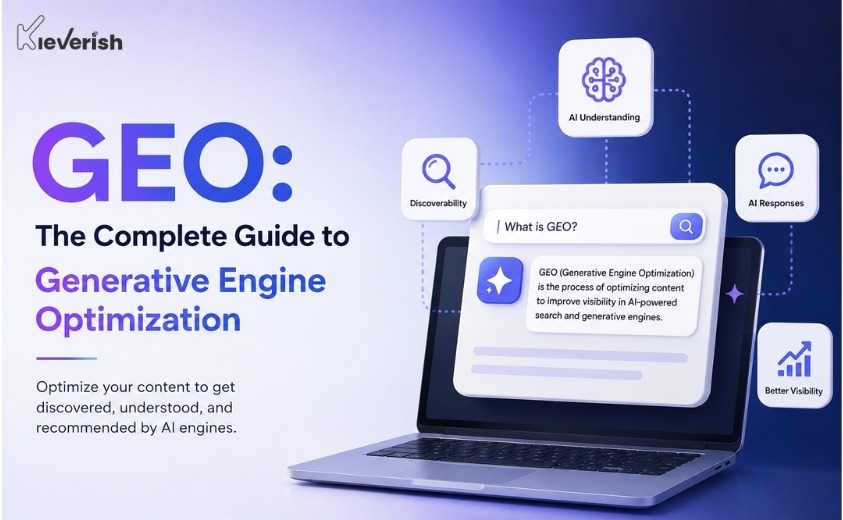

 ×
×

Search is changing. People are no longer relying exclusively on traditional search engines to find information. Increasingly, they are asking AI-powered platforms questions and expecting direct, summarized answers.
This shift has created a new area of digital marketing: Generative Engine Optimization (GEO).
GEO focuses on making websites and content easier for AI-powered search and answer engines to discover, understand, retrieve, summarize, and cite.
But GEO does not mean abandoning traditional SEO. In fact, a strong GEO strategy usually starts with a strong SEO foundation.
Generative Engine Optimization (GEO) is the process of optimizing a website’s content, structure, authority, and information signals so that AI-powered search and answer engines can better understand and potentially reference that content when generating responses.
Traditional SEO primarily focuses on improving visibility in search engine results pages.
GEO expands the objective:
Instead of only asking, “How can we rank this page?” GEO asks, “How can we make this information useful, understandable, trustworthy, retrievable, and citable by AI systems?”
This distinction is important because AI-generated answers often combine information from multiple sources rather than simply displaying a list of blue links.
SEO and GEO are closely related, but they optimize for different stages of the information-discovery process.
| Traditional SEO | GEO |
| Focuses on search engine visibility | Focuses on visibility within AI-generated answers |
| Optimizes pages for rankings | Optimizes information for retrieval and citation |
| Targets keywords and search intent | Targets questions, concepts, entities, and information needs |
| Builds backlinks and authority | Builds authority and citation-worthy information |
| Focuses heavily on SERPs | Focuses on AI answers, mentions, and citations |
| Optimizes for search crawlers | Optimizes content for machine understanding and retrieval |
The two disciplines should therefore work together.
SEO creates the foundation. GEO builds on that foundation.
Yes—but there is an important limitation.
A website can publish excellent GEO-focused content while still having technical SEO problems. However, those problems can make it harder for search and AI systems to discover, crawl, index, interpret, or trust the content.
For example, imagine a company publishes an excellent article about:
“The Best CRM Software for Small Businesses”
The article contains original research, clear comparisons, expert insights, and well-structured answers.
But the website has:
The content may still provide value, but its potential visibility is constrained.
That’s why a practical GEO strategy should begin with the fundamentals of SEO.
Technical SEO → Discoverability → Content quality → Authority → Entity understanding → GEO visibility
GEO is not a replacement for SEO.
It is an additional optimization layer.
When an AI-powered search system answers a question, it needs useful information to work with.
A simplified process looks like this:
User question
↓
AI/search system interprets the intent
↓
Relevant information is retrieved
↓
Sources are evaluated
↓
Information is synthesized
↓
Answer is generated
↓
Relevant sources may be mentioned or cited
This means content creators should not only think about keywords.
They should think about whether a piece of content contains clear, independently understandable, trustworthy information that can be retrieved and used as evidence.
AI-friendly content should not force readers—or machines—to search through hundreds of words before finding the core answer.
For example:
Generative Engine Optimization is the practice of optimizing digital content so AI-powered search and answer systems can better discover, understand, retrieve, and potentially cite that information.
The article can then provide the deeper explanation.
This structure helps both users and information-retrieval systems quickly identify the main answer.
Instead of writing one enormous block of information, organize content around specific questions.
For a GEO guide, useful sections might include:
Each section should answer a clearly identifiable question.
This creates content that is easier to navigate, understand, summarize, and potentially retrieve.
One of the biggest differences between ordinary content and GEO-focused content is specificity.
Consider this:
SEO is very important for GEO.
It’s vague.
A stronger statement is:
Technical SEO supports GEO because AI search systems need to discover and access web content before that content can become a potential source for retrieval and citation.
The second statement contains a clear relationship between two concepts.
That makes it much more useful as an information unit.
AI systems may retrieve individual passages rather than treating an article as one giant block.
Therefore, avoid vague references such as:
This is particularly important for GEO.
Instead:
Clear content structure is particularly important for GEO because it helps AI systems identify the topic, context, and meaning of individual sections.
The second sentence remains understandable even when separated from the surrounding paragraphs.
This is an important principle for AI-retrieval-oriented content:
Make important claims context-independent.
Traditional SEO has historically placed significant emphasis on keywords.
GEO requires a broader understanding of the subject.
For example, an article about CRM software might need to establish relationships between:
HubSpot → CRM → small businesses → marketing automation → sales pipeline
and:
Salesforce → CRM → enterprise → customization → integrations
The goal isn’t to repeatedly use “CRM software.”
The goal is to establish who or what the entities are, what they do, and how they relate to other concepts.
This helps create a clearer information structure around the topic.
Structured data can provide machine-readable information about a page and the entities it represents.
Depending on the business and content, relevant schema types may include:
Structured data should accurately represent visible and relevant information on the page.
It should not be treated as a shortcut for GEO visibility.
Instead, think of it as another way of making the meaning and relationships within your content easier for machines to interpret.
If your most valuable information exists only inside an image, infographic, video, or interactive interface, it becomes harder to retrieve as ordinary text.
For example, don’t rely exclusively on a graphic that says:
Company A — 42%
Company B — 31%
Company C — 27%
Also explain the finding in text:
In the analyzed dataset, Company A represented 42% of the market, followed by Company B at 31% and Company C at 27%.
The visual can remain.
But the important information is also available as text.
This is one of the strongest opportunities in GEO.
Thousands of websites can write:
“AI is changing search.”
Far fewer can say:
“We analyzed 1,000 commercial search queries and found that 38% produced an AI-generated answer containing at least one brand citation.”
Original research gives other publishers, researchers, journalists, and AI systems something substantially more useful to reference.
Businesses can create citation-worthy assets through:
For digital marketing agencies such as Kleverish, this can be particularly valuable because campaign data, search behavior analysis, and client-industry research can become original content assets.
The key is to publish methodology alongside the findings so readers can understand where the data came from.
If your article makes a factual claim, provide evidence whenever appropriate.
For example:
According to Google’s documentation, structured data can help search engines understand the content of a page.
A reader can then verify the statement against the original source.
For GEO, this creates an important evidence chain:
Claim → Evidence → Source
Primary sources are generally preferable for important claims, including:
This is much stronger than repeatedly citing secondary blogs that themselves cite another website.
One article about GEO is unlikely to establish comprehensive topical authority.
A stronger strategy is to build a connected content ecosystem.
For example:
What Is Generative Engine Optimization?
Supporting articles:
These pages should be connected through relevant internal links.
The result is a stronger topical structure rather than a collection of disconnected articles.
AI-generated answers can be particularly sensitive to outdated information.
This matters especially for topics involving:
Don’t simply change the “last updated” date.
Actually review the content.
Remove outdated claims, update statistics, replace broken sources, and add new evidence.
For businesses implementing GEO, content freshness should therefore be part of an ongoing content-maintenance process.
Your website isn’t the only place where your brand’s information exists.
AI systems can encounter your company through:
This creates a broader entity ecosystem around the brand.
For example, if someone searches for:
“Best digital marketing agencies for SaaS companies“
a strong digital presence isn’t only about the agency’s own service page.
The brand may also benefit from credible third-party references, expert contributions, case studies, and industry mentions.
This is why GEO should be considered both a content strategy and an authority strategy.
Keyword research remains useful.
But GEO content should go beyond:
“What keyword has the highest search volume?”
Ask:
What questions are people actually trying to answer?
For example, instead of targeting only:
a business could create content around:
These questions create opportunities for direct answers and deeper topical coverage.
A strong GEO-oriented article can follow this structure:
Direct answer
A concise definition or answer to the primary question.
Explain the concept in greater depth.
Explain the business or user impact.
Break the process into logical steps.
Provide concrete examples.
Add research, data, expert insights, or primary sources.
Explain what businesses can actually do.
Address misconceptions and weak approaches.
Answer related questions clearly.
Provide credible supporting references.
This structure works because it serves both human readers and machine information retrieval.
Traditional SEO metrics such as rankings and organic traffic remain valuable, but GEO requires additional measurements.
Consider tracking:
How frequently does the AI system mention your brand?
How frequently does it cite your website?
How often is your website cited compared with competitors?
For how many relevant questions does your brand appear?
Are you one of the primary sources, or are you buried among many references?
Does the AI describe your company, products, and services correctly?
Which competitors appear when your brand doesn’t?
These measurements provide a more complete view of AI visibility than simply asking whether your website “ranks.”
GEO should complement technical SEO, content SEO, authority building, and user experience.
Repeating phrases such as “AI search optimization” doesn’t automatically make content GEO-friendly.
Information quality matters more than artificial keyword insertion.
If your article says the same things as 500 other websites, there’s little reason for an AI system to prefer it as a source.
Original insight matters.
Strong statements without evidence can weaken credibility.
Excellent content cannot compensate indefinitely for serious crawlability, indexability, or architecture problems.
Brand authority is built across the wider web.
A page can have strong traditional rankings but limited visibility in AI-generated answers—and vice versa.
The industry sometimes frames GEO as the replacement for traditional SEO.
That’s the wrong way to look at it.
The better model is:
Technical SEO
↓
High-quality content
↓
Topical authority
↓
Entity clarity
↓
Original information & evidence
↓
AI retrieval
↓
Brand mention & citation
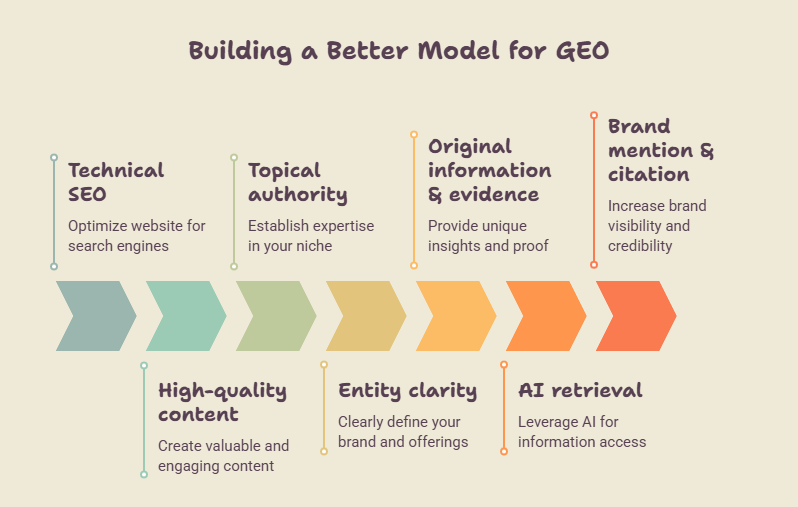
Traditional SEO helps make your content discoverable and accessible.
High-quality content makes it useful.
Authority and evidence make it trustworthy.
GEO brings these elements together with an additional focus on how AI systems retrieve, interpret, summarize, and potentially cite information.
GEO isn’t about trying to “hack” ChatGPT or another AI platform.
It’s about creating information that machines can understand and people can trust.
The strongest GEO strategy therefore isn’t:
“Write content for AI.”
It’s:
“Create authoritative, well-structured, evidence-backed information that is easy for both humans and machines to understand.”
For businesses, the practical starting point is straightforward:
Fix technical SEO → understand user questions → create authoritative content → make answers easy to extract → strengthen entity signals → publish original research → earn credible mentions → monitor AI visibility.
That’s where traditional SEO and GEO work together.
And for a digital marketing agency such as Kleverish, the opportunity is not simply to add “GEO” as another service label. The bigger opportunity is to integrate GEO into the existing SEO, content, authority, and digital PR strategy—creating a unified approach to visibility across traditional search and AI-powered discovery.
What does GEO mean?
GEO stands for Generative Engine Optimization. It is the practice of optimizing content so AI search engines and generative AI platforms can understand, cite, and recommend it in AI-generated answers. GEO complements traditional SEO by focusing on visibility across AI-powered search experiences.
What are the two types of GEO?
The two common meanings of GEO are Generative Engine Optimization and Geographic/Geospatial Optimization, depending on the context. In digital marketing, GEO usually means Generative Engine Optimization, which helps content appear in AI-generated search results and recommendations.
Is GEOAI free?
GEOAI pricing depends on the specific tool or platform. Some GEO AI tools offer free plans, trials, or limited features, while advanced platforms typically require a paid subscription. Always check the provider’s current pricing, features, usage limits, and plan restrictions before choosing a GEO AI solution.
What is GEO and how does it work?
Generative Engine Optimization (GEO) improves content visibility in AI-generated search results. It works by creating authoritative, well-structured, factual content that AI systems can understand, extract, summarize, and cite. GEO uses strategies such as clear answers, relevant entities, credible sources, and strong topical coverage.
What’s the difference between GEO and SEO?
SEO (Search Engine Optimization) focuses on improving rankings and organic traffic in traditional search engines. GEO (Generative Engine Optimization) focuses on getting content cited, mentioned, or recommended by AI search and generative engines. SEO targets search rankings, while GEO targets visibility within AI-generated answers.
Will GEO replace SEO?
No, GEO is unlikely to replace SEO. GEO and SEO serve different but increasingly connected purposes. SEO helps websites earn organic search visibility, while GEO helps content appear in AI-generated answers. The strongest digital marketing strategy combines SEO fundamentals with GEO optimization for traditional and AI search.
Which is better, SEO or GEO?
Neither SEO nor GEO is universally better. SEO remains essential for traditional search rankings and website traffic, while GEO helps brands gain visibility in AI-generated answers. For the best results, businesses should use SEO and GEO together to reach users across search engines and AI platforms.
Is SEO dead now with AI?
No, SEO is not dead because of AI. Search engines still rely heavily on websites, authoritative content, technical SEO, and structured information. AI is changing how people discover information, making GEO an important complement to SEO, rather than eliminating the need for search engine optimization.
Is SEO still worth it in 2027?
Yes, SEO is still worth it in 2027. SEO remains valuable for building organic visibility, website traffic, brand authority, and long-term discoverability. However, businesses should adapt their strategy for AI search by combining traditional SEO, high-quality content, structured data, and Generative Engine Optimization (GEO).

Hey, Raj Trivedi here! A Results-driven Sr. SEO Executive in Kleverish with extensive experience of 6 years in developing and implementing On-page SEO, Off-page SEO and Technical SEO techniques to enhance website visibility and organic growth. Experienced in keyword research, SEO audits, and content optimization to improve search engine rankings in SERPs.



 Rated 4.99/5 overall
across 100+ reviews
Rated 4.99/5 overall
across 100+ reviews