SEO & Lead Generation
  Google Adwords Management
 Social Media Management
 Ecommerce Marketing
 WordPress & Shopify Services
 Website & App Designing
  Website Speed Optimization
  Website Hosting Services
  Amazon PPC Marketing
  Landing Page Designing
 Logo Designing Services

 ×
×

The way people search for information is changing fast. Traditional search engines are no longer the only place where users find answers. Today, users are asking questions directly to AI tools, and those tools are giving instant, summarized, and highly relevant answers.
This shift has introduced a new concept in digital marketing: Generative Engine Optimization (GEO).
If you want your brand to stay visible in 2026 and beyond, you need to understand how AI search works and how to optimize your content for it.
In this detailed guide by Kleverish, you’ll learn what GEO is, how it works, and exactly how to rank on AI platforms like ChatGPT, Perplexity, and Google AI.
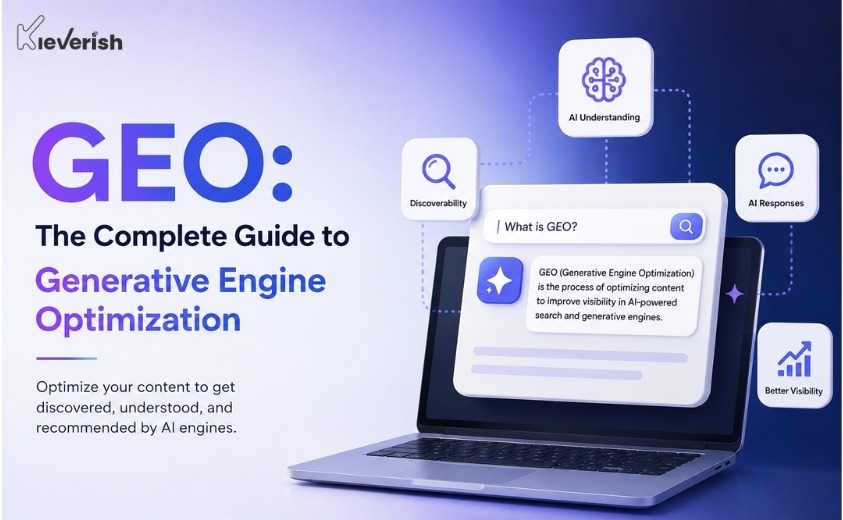
Generative Engine Optimization (GEO) is the process of optimizing your content so that AI-powered platforms can find, understand, and recommend it in their answers.
Unlike traditional SEO, where your goal is to rank on search engine result pages (SERPs), GEO focuses on getting featured inside AI-generated answers.
In simple terms:
AI tools don’t just show links—they generate answers. And those answers are based on content they trust, understand, and consider authoritative.
So if your content is not optimized for AI, you’re invisible in this new search ecosystem.
User behavior has changed dramatically. Instead of typing short keywords like “best SEO agency,” people now ask:
AI tools provide direct answers without forcing users to click multiple links. This means:
If your content is not optimized for AI search, you are missing out on a massive opportunity.
GEO ensures that your brand, like Kleverish, appears directly in answers when users ask relevant questions.
Understanding the difference between GEO and SEO is crucial if you want to succeed in AI search optimization.
SEO focuses on:
The goal is simple: Get users to click your website link.
GEO focuses on:
The goal is different: Get your content used in AI-generated answers.
| Factor | SEO | GEO |
| Goal | Rank on SERPs | Get featured in AI answers |
| Content | Keyword-focused | Context-focused |
| Format | Blog & landing pages | Structured, answer-based |
| User Behavior | Click links | Read AI responses |
| Ranking Signal | Backlinks | Authority + clarity |
In 2026, both SEO and GEO are important. But GEO is becoming essential.
To rank in AI search, you need to understand how AI tools process information.
AI platforms:
They don’t just pick one page—they combine information.
This means:
If your content is vague, promotional, or keyword-stuffed, AI will ignore it.
Ranking on AI tools like ChatGPT is not about tricks—it’s about clarity and authority.
AI tools are built to answer questions.
Instead of writing generic content, create sections like:
This makes it easier for AI to extract your content.
AI prefers content that is easy to understand.
Avoid:
Use:
Your goal is to make AI understand your content instantly.
Don’t write half answers.
If the topic is “how to rank on ChatGPT,” your content should include:
AI prefers complete and valuable content.
AI trusts websites that cover a topic deeply.
Instead of writing one blog on GEO, create:
This builds authority.
If you want your brand, like Kleverish, to appear in AI answers, you need to:
Example:
Kleverish helps businesses implement AI search optimization strategies for better visibility in generative engines.
Google AI Overviews are changing how search results appear.
Instead of showing just links, Google now gives AI-generated summaries at the top.
To rank here:
Use:
This makes it easier for Google to extract your content.
If someone searches:
“How to rank in AI search.”
Your content should immediately answer that question.
No unnecessary introduction.
Instead of repeating one keyword, include related terms like:
This improves context.
AI prefers content backed by:
This increases trust.
Perplexity works differently from traditional search engines.
It:
To rank on Perplexity:
Avoid overly promotional content.
Focus on:
Content should be:
Outdated content won’t be picked.
Perplexity often shows sources.
To get cited:
AI content optimization is the backbone of GEO.
Here’s how to do it effectively:
AI prefers human-like writing.
Avoid a robotic tone.
Your content should follow:
This helps AI understand structure.
Instead of repeating:
“generative engine optimization”
Use variations naturally.
AI tools prefer fresh content.
Update blogs regularly with:
Formatting improves readability:
This increases AI extraction chances.
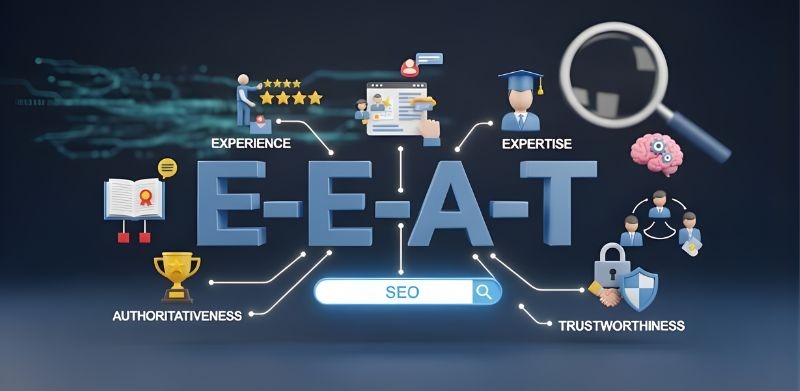
When it comes to ranking in AI search, trust matters more than ever. AI platforms don’t just pick any content; they prefer content that clearly shows real experience and genuine expertise. If your content feels generic or lacks depth, it’s unlikely to be included in AI-generated answers.
This is where E-E-A-T becomes important. Your content should show that you actually understand the topic, not just rewrite information. Adding real insights, practical examples, and credible references helps build that trust. Even small things like mentioning who created the content or sharing real-world results can make a big difference.
For a brand like Kleverish, this means focusing on creating content that is not only optimized for AI but also genuinely helpful and reliable. Because in AI search, the more trustworthy your content is, the higher the chances it gets picked up and recommended.
If you want a practical roadmap, follow this:
Find what users are asking about your topic.
Write detailed blogs (like this one).
Use headings and sections.
Make your content useful.
Publish multiple related articles.
If humans understand your content, AI will too.
GEO is not a trend—it’s the future.
In the coming years:
Brands that adapt early will win.
Those who rely only on traditional SEO will struggle.
Many businesses fail because they:
If you avoid these mistakes, your chances of ranking increase significantly.
At Kleverish, we understand that the future of search is AI-driven.
We don’t just focus on rankings—we focus on visibility where it matters most:
Our approach includes:
We help brands not just rank but get recommended by AI.
Generative Engine Optimization is transforming digital marketing.
If you want to stay ahead in 2026, you need to shift your strategy from traditional SEO to AI search optimization.
Focus on:
Because in the AI era, it’s not about who ranks first…
It’s about who gets mentioned in the answer.
If you want your brand to appear in ChatGPT, Google AI, and Perplexity results, now is the time to act.
Kleverish can help you build a powerful GEO strategy that drives real visibility and growth.
Start optimizing today because AI search is already here.

Hey there! I’m Payal Tejwani, a SEO Executive at Kleverish dedicated to helping brands shine online. I focus on keyword research, on-page SEO, and content optimization to boost organic traffic and visibility. Always curious about the latest SEO trends, I enjoy turning insights into strategies that truly work.



 Rated 4.99/5 overall
across 100+ reviews
Rated 4.99/5 overall
across 100+ reviews