SEO & Lead Generation
  Google Adwords Management
 Social Media Management
 Ecommerce Marketing
 WordPress & Shopify Services
 Website & App Designing
  Website Speed Optimization
  Website Hosting Services
  Amazon PPC Marketing
  Landing Page Designing
 Logo Designing Services

 ×
×

Search is no longer limited to typing a few keywords into Google. Today, people ask questions, speak naturally, and expect fast, accurate answers. Whether it’s through smartphones, smart speakers, or voice assistants, the way users interact with search engines has completely changed.
However, one important thing remains clear — traditional SEO is not dead. It has simply evolved.
In 2026, businesses that succeed are those that understand how to combine voice search SEO with strong traditional SEO strategies. This combination helps improve visibility, increase traffic, and deliver better user experiences.
This blog explains what has changed, what still works, and how you can adapt your SEO strategies in 2026 to stay ahead of competitors.
Search behavior today is faster, smarter, and more focused on user intent. People are no longer searching in fragments; they are searching in complete, natural sentences.
This shift clearly shows how important it is to adapt your SEO strategy. Voice search optimization is no longer optional; it is a necessary part of modern SEO.
Traditional SEO focuses on optimizing websites for users who type queries into search engines. It is the foundation of digital visibility and still plays a critical role in rankings.
Even with the rise of voice search, traditional SEO remains essential for several reasons:
At kleverish, we have consistently observed that websites with a strong traditional SEO foundation perform better across all types of search, including voice search.
Voice search SEO focuses on optimizing content for spoken queries. It is designed to match how people naturally speak rather than how they type.
Voice search SEO works by understanding user intent and delivering clear, concise answers that match spoken queries.
Understanding the differences between these two approaches helps you build a more effective SEO strategy.
This comparison highlights an important point: voice search is focused on delivering the best answer, not just listing options.
Voice search is not just a trend; it is a long-term shift in user behavior.
Businesses that ignore voice search SEO risk losing visibility, traffic, and potential customers.

Instead of choosing between voice search and traditional SEO, the most effective approach is to combine both.
Here are the strategies that are working best in 2026:
Search engines now prioritize the purpose behind a query rather than just the keywords.
Instead of targeting:
“SEO services”
Target:
“How to choose the best SEO services for small businesses”
This approach improves both rankings and user engagement.
Voice search queries are natural and human-like, so your content should match that tone.
At kleverish, we focus on creating human-friendly content that is easy to understand and performs well in search results.
Long-tail keywords are essential for voice search optimization.
Featured snippets are often used by voice assistants to provide answers.
Voice searches are mostly done on mobile devices, so performance matters.
A slow website can negatively impact both rankings and user experience.
Voice searches often have local intent.
“SEO company in Ahmedabad”
“Best cafe near me”
Structured data helps search engines understand your content more effectively.
Voice search users typically ask questions.
Instead of writing:
“SEO tips 2026”
Write:
“What are the best SEO strategies in 2026 for small businesses?”
Search engines prioritize reliable and trustworthy content.
At kleverish, we prioritize reliability because trust plays a major role in ranking success.
AI-generated summaries are becoming a major part of search results.
AI systems prefer content that is helpful, structured, and easy to understand.
Use this checklist to improve your SEO performance:
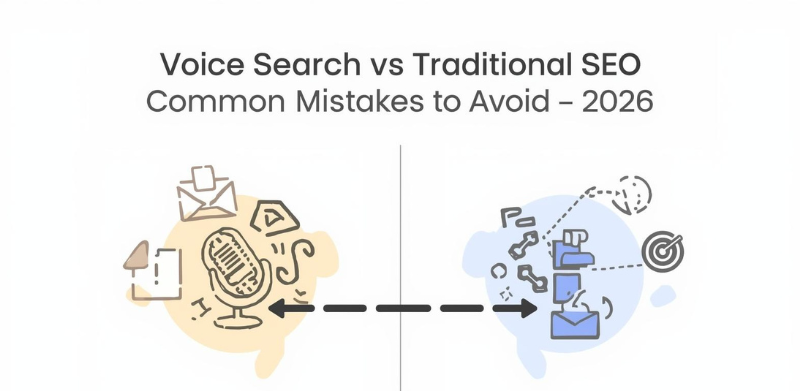
Avoiding these mistakes can improve your rankings significantly.
Many businesses still rely only on traditional SEO, missing out on new opportunities.
Overusing keywords makes content difficult to read and harms rankings.
Outdated content loses relevance and visibility.
A slow or unresponsive website negatively affects performance.
Content should always be created for users first.
SEO will continue to evolve with advancements in AI and voice technology.
Businesses that adapt early to these changes will gain a strong competitive advantage.
The discussion of voice search vs traditional SEO is not about choosing one over the other.
The real success in 2026 comes from integration.
To achieve long-term growth, businesses must combine both approaches into a single, well-planned strategy.
At kleverish, we help businesses create reliable, future-ready SEO strategies that work across all platforms and search behaviors.
Search is evolving, but the goal remains the same — providing the best possible answer to users.
By combining traditional SEO with voice search optimization, focusing on user intent, and creating high-quality content, you can stay ahead in 2026 and beyond.The businesses that adapt to these changes today will be the ones leading search rankings tomorrow.

Hello! I ‘am Harshita Bhatt, an SEO Executive at Kleverish with expertise in keyword research, on-page SEO, and content optimization. I focus on improving organic search performance and enhancing online visibility through data-driven strategies. I continuously stay updated with evolving SEO trends to deliver measurable and sustainable results.



 Rated 4.99/5 overall
across 100+ reviews
Rated 4.99/5 overall
across 100+ reviews