SEO & Lead Generation
  Google Adwords Management
 Social Media Management
 Ecommerce Marketing
 WordPress & Shopify Services
 Website & App Designing
  Website Speed Optimization
  Website Hosting Services
  Amazon PPC Marketing
  Landing Page Designing
 Logo Designing Services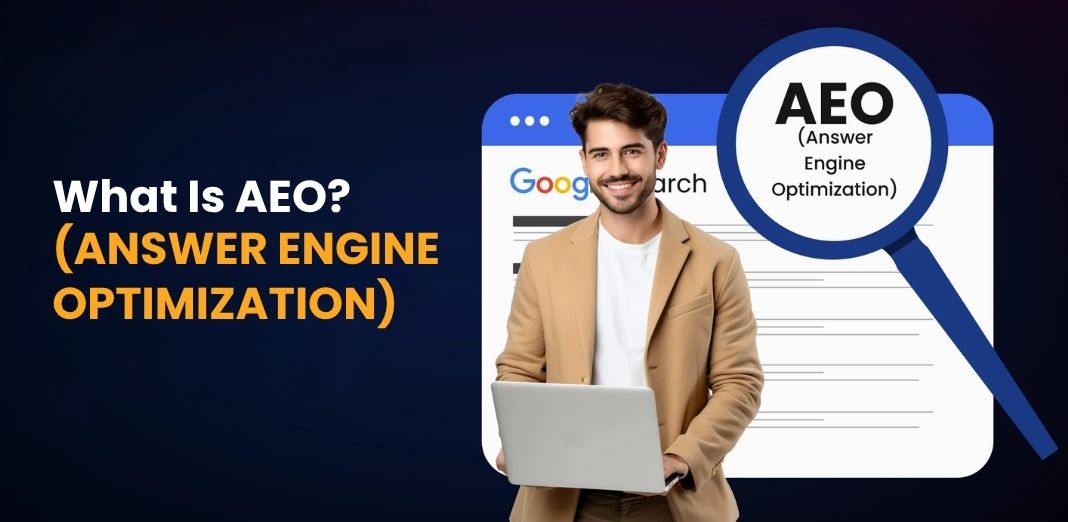

 ×
×

Position Your The digital marketing landscape is undergoing a profound transformation in 2025, with a clear shift from traditional search engine optimization (SEO) to AEO Search. As users increasingly rely on AI tools like ChatGPT, Google SGE, Bing Copilot, and Perplexity AI to answer their queries, content creators and marketers must evolve their strategies to ensure their information is accessible, relevant, and primed for AI interpretation.
This guide unpacks everything you need to know about AEO in 2025—what it is, why it matters, how to optimize for it, and where it’s headed in the future.
Answer Engine Optimization (AEO) refers to the process of optimizing content to deliver clear, concise, and authoritative answers to user queries in AI-powered environments. Unlike traditional SEO, which targets keyword rankings and backlink building, AEO focuses on contextual understanding, intent matching, and structuring content in ways that artificial intelligence systems can easily parse and serve as direct answers.
| SEO | AEO |
|---|---|
| Keyword-driven | Intent-driven |
| Optimized for search engines | Optimized for AI models & answer engines |
| Focused on SERPs and traffic | Focused on visibility in AI results |
| Relies on backlinks | Relies on clarity, authority, and context |
The way users search for information has evolved dramatically:
If your business isn’t optimized for AI discovery, you’re missing out on valuable visibility and trust. Brands that succeed in AEO are the ones showing up in voice assistants, smart answers, featured snippets, and chatbot responses.

At the heart of AEO lies user intent. It’s not enough to target keywords—you must understand why someone is searching and what exact information they want.
🔍 Tip: Use tools like AlsoAsked, AnswerThePublic, and Google’s People Also Ask (PAA) to uncover real questions users are asking.
What is Answer Engine Optimization (AEO)?
Answer Engine Optimization (AEO) is the process of creating and structuring content so that AI-powered systems can easily extract and serve it as direct answers to user queries.
Schema markup is critical in helping search engines and AI understand what your content is about.
✅ Implementing the right schema increases the chance your content appears in featured snippets, voice searches, and AI cards.
AI platforms favor content from authoritative and credible sources. To build authority:
Main Topic: AEO Strategy
Supporting Articles: “AEO vs SEO”, “Top Tools for AEO”, “How to Write for ChatGPT”
With the rise of Alexa, Siri, and voice-enabled AI tools, your content must be ready for spoken search.
🗣 Users often ask: “How do I optimize my website for AI answers?” Your content should literally include and answer this question directly.

Don’t forget the backend:
While these are traditional SEO elements, they remain foundational for any AI crawling or indexing.
As AI engines vet content for quality and reliability, Google’s E-E-A-T principles still apply:
Publish bylined content with expert profiles, cite credible sources, and avoid fluff.
| Item | Status |
|---|---|
| Answered real user questions | ✅ |
| Used schema markup | ✅ |
| Included bullet points/lists | ✅ |
| Structured Q&A format | ✅ |
| Voice-friendly language | ✅ |
| Linked to other related content | ✅ |
| Bylined expert content | ✅ |
| Mobile-first, fast-loading pages | ✅ |
The line between AI and search will continue to blur. Here’s what the future holds:
AEO isn’t a replacement for SEO—it’s the natural evolution of it. In 2025, being discoverable means being answerable. Brands that anticipate the AI-driven future will be the ones leading conversations, dominating AI summaries, and winning customer trust at scale.
Whether you’re a marketer, content creator, or business owner, now is the time to rethink how you create content—not just for search engines, but for answer engines.

Working as a Frontend Developer at Kleverish has been an enriching and valuable experience. I have worked on real-world UI components, responsive layouts, and strengthened my skills in HTML, CSS, and JavaScript. The team has been incredibly supportive, helping me dive deeper into modern frontend practices such as performance optimization, clean code architecture, and improved development workflows. My role at Kleverish has significantly enhanced my technical expertise and overall understanding of professional frontend development.



 Rated 4.99/5 overall
across 100+ reviews
Rated 4.99/5 overall
across 100+ reviews