SEO & Lead Generation
  Google Adwords Management
 Social Media Management
 Ecommerce Marketing
 WordPress & Shopify Services
 Website & App Designing
  Website Speed Optimization
  Website Hosting Services
  Amazon PPC Marketing
  Landing Page Designing
 Logo Designing Services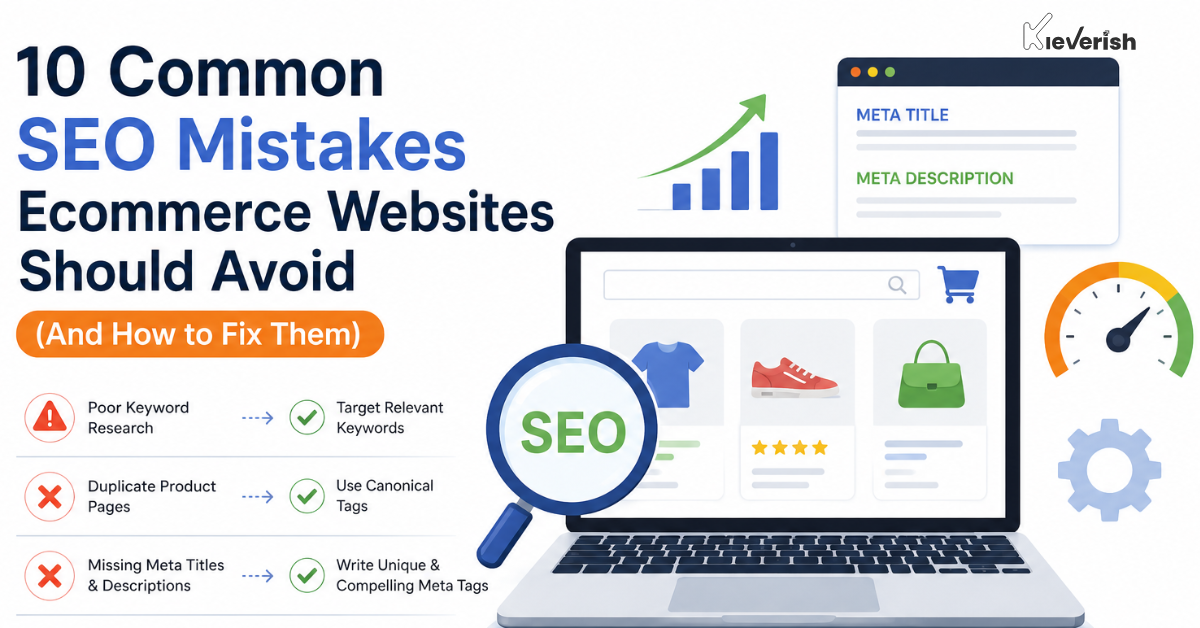

 ×
×

If your ecommerce store isn’t showing up on the first page of Google, you’re not just losing rankings — you’re losing sales. Every day a competitor outranks you for a high-intent search, they’re capturing the traffic, trust, and revenue that should be yours.
Ecommerce SEO is different from regular SEO. You’re not just optimizing blog posts — you’re optimizing thousands of product pages, collection pages, and category structures, all while competing against marketplaces, aggregators, and other brands fighting for the same keywords. A handful of avoidable ecommerce SEO mistakes are usually the reason stores plateau instead of grow.
In this guide, we’ll walk through the 10 most common ecommerce SEO mistakes online stores make — from technical issues to content gaps — and show you exactly how to fix each one. Whether you’re running a Shopify store, a Magento build, or selling on Amazon, this checklist applies across platforms and is designed to help you turn your storefront into a consistent source of organic traffic and revenue.
The single biggest ecommerce SEO mistake is skipping proper keyword research and guessing at what customers search for.
Targeting broad keywords Many store owners try to rank for high-volume, generic terms like “shoes” or “phone case.” These keywords are dominated by billion-dollar marketplaces and brand giants — a new or mid-sized store has almost no chance of competing. Worse, broad keywords rarely convert because they don’t reflect specific buying intent.
Ignoring buyer intent Not all searches are equal. Someone searching “what are running shoes” is researching. Someone searching “buy men’s running shoes size 10” is ready to purchase. If your keyword strategy doesn’t distinguish between informational, comparison, and transactional intent, you’ll attract visitors who never convert.
How to find the right keywords
Getting this foundation right makes every other SEO effort more effective.
Your product pages are your most important SEO assets — and also the most commonly neglected.
Thin descriptions A two-line description with no detail gives Google (and shoppers) nothing to work with. Thin content signals low relevance and rarely ranks.
Duplicate manufacturer content Copy-pasting the manufacturer’s product description might save time, but it means your page is identical to hundreds of other retailers selling the same item. Search engines struggle to differentiate — and often won’t rank duplicate content at all.
Missing product benefits Listing specs isn’t enough. Shoppers (and search engines) respond to content that explains why a product matters — the problem it solves, who it’s for, and how it compares to alternatives.
How to fix it:
This is one of the highest-impact areas of product page SEO, and it’s exactly where services like eStore Factory’s Product Listing Optimization can help transform underperforming listings into high-converting, search-friendly pages.
Ecommerce sites are especially prone to duplicate content because of how catalogs are structured.
Similar product pages Variants of the same product (different colors, sizes) often generate near-identical pages, which confuses search engines about which version to rank.
Collection pages Filtered and sorted versions of the same collection (by price, color, size) can generate dozens of URL variations with the same content — a major cause of index bloat.
Canonical tags The fix is technical: implement canonical tags to tell search engines which version of a page is the “master” copy. Without them, your ranking signals get split across multiple URLs instead of consolidating on one strong page.
How to fix it:
Speed is both a ranking factor and a conversion factor — a slow store loses on both fronts.
Large images Unoptimized, high-resolution product images are one of the top causes of slow load times on ecommerce sites.
Heavy scripts Too many apps, plugins, and third-party scripts (especially on Shopify) can significantly bloat page weight and delay rendering.
Slow checkout A sluggish checkout process doesn’t just hurt conversions — cart abandonment and bounce rates are behavioral signals that can indirectly affect rankings.
Core Web Vitals Google’s Core Web Vitals (Largest Contentful Paint, Interaction to Next Paint, Cumulative Layout Shift) are now direct ranking factors. Poor scores here can quietly cap your visibility no matter how good your content is.
How to fix it:
Search engines and shoppers both need to find products quickly and logically.
Too many clicks to products If a product is buried four or five clicks deep from the homepage, it dilutes link equity and makes it harder for search engines to crawl and rank.
Poor navigation Confusing menus and categories increase bounce rates and make it harder for customers (and crawlers) to understand your catalog.
Broken internal linking Orphaned pages — products or categories with no internal links pointing to them — are often invisible to search engines entirely.
How to fix it:
A strong structure is the backbone of solid technical SEO for ecommerce and makes every other optimization effort more effective.
The majority of ecommerce traffic — and often revenue — now comes from mobile devices.
Mobile-first indexing Google predominantly uses the mobile version of your site for indexing and ranking. If your mobile experience is worse than desktop, your rankings suffer directly.
Responsive design A site that isn’t fully responsive creates layout issues, unreadable text, and broken functionality on smaller screens — all of which hurt both usability and SEO.
Mobile checkout A clunky mobile checkout is one of the biggest silent killers of ecommerce conversion rates.
How to fix it:
Metadata is often the first thing a potential customer sees in search results — and it’s frequently left on autopilot.
Poor CTR Generic or missing meta titles and descriptions lead to poor click-through rates, even when you’re ranking well. Google may also rewrite them automatically, often to less compelling copy.
Writing optimized metadata Every page should have a unique, keyword-rich title and description that reflects the actual content and entices a click.
Examples
How to fix it:
Product images are essential to conversions, but they’re often an untapped SEO opportunity.
Image compression Uncompressed images slow down pages and hurt Core Web Vitals scores.
File names Generic file names like “IMG_2938.jpg” tell search engines nothing about the image content, missing an easy ranking opportunity.
Alt text Missing alt text is both an accessibility issue and a lost chance to rank in Google Image search — a channel that drives meaningful traffic for visual products.
How to fix it:
Technical issues can quietly cap your visibility even when your content and product pages are strong.
XML sitemap An outdated or missing sitemap means new products and pages may take much longer to be discovered and indexed.
Robots.txt Misconfigured robots.txt files can accidentally block search engines from crawling important pages — a surprisingly common and costly mistake.
Schema markup Product schema (price, reviews, availability) enables rich results in search — star ratings, pricing, and stock status directly in the search listing — which significantly improves CTR.
Broken links & crawl errors 404s, redirect chains, and crawl errors waste crawl budget and create poor user experiences.
How to fix it:
This is the foundation of solid technical SEO for ecommerce — invisible to shoppers, but critical to how search engines evaluate your site.
Many ecommerce sites treat content as an afterthought, missing a major traffic opportunity.
No blog Without a blog, you have no way to target informational and top-of-funnel keywords that bring in new visitors before they’re ready to buy.
No buying guides Buying guides and comparison content capture shoppers in the research phase and build trust ahead of the purchase decision.
No category content Category pages with zero supporting content miss the chance to rank for broader, high-volume terms tied to that product group.
Internal linking Content also creates internal linking opportunities that pass authority to your product and category pages.
How to fix it:
A consistent content strategy is one of the most underrated parts of ecommerce marketing — and one of the most effective ways to build long-term organic traffic that doesn’t depend on paid ads.
Use this quick ecommerce SEO checklist to audit your store:
Fixing these issues one at a time is manageable — but scaling it across an entire catalog, while also managing ads, conversion rates, and platform-specific requirements, is where most ecommerce teams run out of time and expertise.
eStore Factory Australia helps ecommerce businesses improve their organic visibility and overall performance through a full suite of services, including:
These services are part of eStore Factory Australia’s broader ecommerce growth offerings, designed to help online stores compete and grow across Shopify, Amazon, and beyond.
SEO mistakes are rarely dramatic — they’re usually small, accumulated gaps: a missing meta description here, a slow-loading image there, a product page copied straight from the manufacturer. But together, these ten issues — from poor keyword research and thin product pages to weak technical foundations and a missing content strategy — can quietly cap how much organic traffic and revenue your store ever earns.
The good news is that every mistake on this list is fixable. Regularly auditing your store against this ecommerce SEO checklist, rather than treating SEO as a one-time setup, is what separates stores that steadily climb the rankings from those that plateau. Prioritize the fixes that affect the most pages first — technical SEO and product page optimization typically deliver the fastest, broadest impact — then build outward into content and structure improvements.
Avoiding these mistakes won’t just improve your rankings. It will attract more qualified traffic, build trust with shoppers before they even land on your site, and steadily increase conversions over time.
1. What is the most common SEO mistake ecommerce stores make?
Poor product page optimization is one of the most widespread issues — thin descriptions, duplicate manufacturer content, and missing product benefits make it hard for pages to rank or convert.
2. How often should I audit my ecommerce store’s SEO?
A full technical and content audit every 3–6 months is a good baseline, with lighter checks (broken links, page speed, indexing) done monthly.
3. Does Shopify have SEO limitations compared to other platforms?
Shopify is generally SEO-friendly, but default themes, app bloat, and duplicate URLs from collections/filters can hurt performance if not managed properly — this is where dedicated Shopify SEO work matters.
4. How does Amazon SEO differ from regular ecommerce SEO?
Amazon SEO focuses on Amazon’s own ranking algorithm (A9/A10) — factors like conversion rate, listing keywords, reviews, and fulfillment method matter more than traditional backlinks or Core Web Vitals.
5. Why is duplicate content such a big issue for online stores?
Product variants, filtered collection URLs, and copied manufacturer descriptions can create dozens of near-identical pages, splitting ranking signals and confusing search engines about which page to rank.
6. How do Core Web Vitals affect ecommerce rankings?
Core Web Vitals are a direct Google ranking factor. Slow-loading product pages or layout shifts during load can lower rankings even if your content and keywords are strong.
7. Do I really need a blog if I run an online store?
Yes — a blog lets you target informational and comparison searches (buying guides, “how to choose,” etc.) that bring in shoppers earlier in their decision process, before they’re ready to buy.
8. What’s the fastest fix for stores that rank poorly right now?
Start with technical SEO (indexing, sitemap, broken links) and product page optimization — these affect the most pages at once and typically show the quickest ranking improvement.
9. Can schema markup really improve click-through rate?
Yes — product schema showing star ratings, price, and stock availability directly in search results tends to noticeably increase CTR compared to plain text listings.
10. Is mobile optimization really that important for ecommerce SEO?
Very much so — Google uses mobile-first indexing, meaning your mobile site is the primary version used for ranking, regardless of how good your desktop experience is.

Hey, Kruti here! I’m a Junior SEO Executive at Kleverish, where I help optimize websites to boost search visibility and drive organic traffic. With a passion for digital strategy, I focus on keyword research, on-page SEO, and content optimization to help brands grow online. I’m always eager to learn the latest in SEO trends and love turning insights into results that matter.



 Rated 4.99/5 overall
across 100+ reviews
Rated 4.99/5 overall
across 100+ reviews