SEO & Lead Generation
  Google Adwords Management
 Social Media Management
 Ecommerce Marketing
 WordPress & Shopify Services
 Website & App Designing
  Website Speed Optimization
  Website Hosting Services
  Amazon PPC Marketing
  Landing Page Designing
 Logo Designing Services

 ×
×

Startups around the world are under pressure to stand out online as global competition heats up. Here’s something that might catch you off guard. Companies with a blog generate 67 percent more leads than those without one. So while flashy ads and viral videos might look tempting, the smartest startups are quietly winning by thinking globally on digital platforms and speaking local across markets. Ready to see why the boldest moves don’t always require deep pockets?
| Takeaway | Explanation |
|---|---|
| Global Digital Presence is Essential | Startups must create a robust, localized digital presence to compete globally, adapting messaging to fit cultural contexts and using advanced technologies for targeted campaigns. |
| Content Marketing is Cost-Effective | Establishing thought leadership through consistent, high-quality content marketing can generate significantly more leads without substantial financial investment. |
| Local Market Adaptation is Crucial | Understanding local digital ecosystems and consumer behaviors is key. Startups must not only translate content but tailor strategies to meet specific cultural and technological dynamics. |
| Data-Driven Insights Optimize Resources | Utilizing performance metrics and sophisticated analytics tools helps startups track effectiveness and reallocate marketing resources efficiently for maximum impact. |
| Dynamic Measurement Frameworks are Necessary | Startups need to develop agile measurement approaches that evolve with market changes, ensuring that insights are timely and relevant for strategic adjustments. |
Startups looking to compete on the global stage must develop a robust digital presence that transcends geographical boundaries. Digital marketing strategies are no longer optional but essential for survival and growth in an interconnected business world.
Successful global digital marketing requires a nuanced approach that goes beyond simple translation. Research published in Heliyon reveals that digital platforms significantly enhance startup performance by providing broader market outreach, cost-effectiveness, and powerful network effects.
Building an effective global digital presence involves multiple strategic components. Localization becomes critical – not just translating content, but adapting messaging to resonate with specific cultural contexts. This means understanding local preferences, communication styles, and digital consumption habits across different markets.
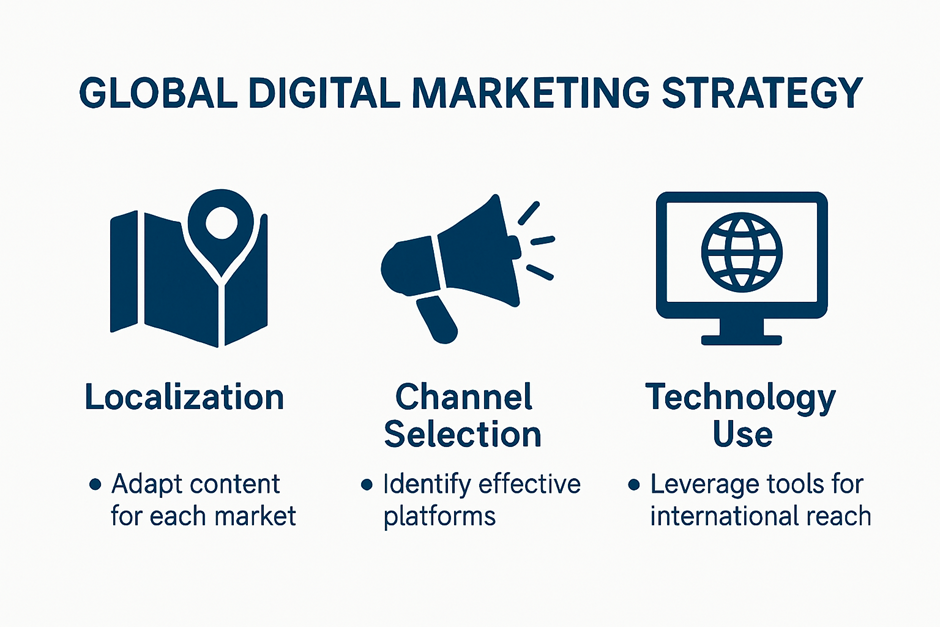
Modern startups must leverage multiple digital channels to create a comprehensive global presence. This includes:
Gartner Research suggests that successful global digital marketing requires a flexible, data-driven approach. Startups must continuously analyze performance metrics, understanding how different regions interact with their digital content and adjusting strategies accordingly.
Advanced digital marketing technologies enable startups to create sophisticated, targeted global campaigns. Artificial intelligence and machine learning tools help startups understand complex international market dynamics, predict consumer behavior, and personalize marketing efforts across different cultural contexts.
Implementing a global digital marketing strategy is not about broadcasting a single message worldwide, but creating a nuanced, adaptive approach that speaks directly to diverse audience segments. This requires deep market research, technological sophistication, and a commitment to understanding cultural nuances.
The most successful startups recognize that global digital presence is more than a technical challenge – it is a complex cultural and strategic endeavor that demands creativity, flexibility, and continuous learning.
Startups operate in a challenging financial landscape where every marketing dollar must deliver maximum impact. Developing smart, budget-conscious digital marketing strategies becomes crucial for survival and growth.
Research reveals that businesses maintaining blogs generate 67% more leads than those without, making content marketing a powerfully cost-effective tactic. This strategy allows startups to establish thought leadership, build trust, and attract potential customers without significant financial investment.
Creating high-quality, targeted content requires understanding audience pain points and delivering genuine value. Startups can leverage blog posts, podcasts, YouTube videos, and social media content to communicate their unique value proposition. The key is consistency and authenticity.
Micro-influencer collaborations offer an affordable alternative to traditional advertising. These niche content creators have highly engaged audiences and can provide authentic promotion at a fraction of mainstream advertising costs.
Email marketing represents another incredibly efficient channel. Studies indicate an impressive return of $36 for every $1 spent, making it an essential tool for nurturing leads and building customer relationships. Startups can leverage automated email sequences, personalized campaigns, and segmented lists to maximize engagement.

Data-driven marketing techniques allow startups to optimize limited budgets. Pay-per-click (PPC) advertising enables precise targeting, ensuring marketing spend reaches the most relevant audience. Social media advertising platforms offer granular demographic and interest-based targeting options.
Search engine optimization (SEO) provides another cost-effective strategy. By optimizing website content, implementing strategic keywords, and building quality backlinks, startups can improve organic search visibility without continuous financial investment.
Analytics tools play a critical role in cost-effective marketing. By tracking key performance indicators, startups can quickly identify which strategies deliver the best returns and reallocate resources accordingly. This agile approach prevents wasteful spending and ensures continuous improvement.
Successful cost-effective marketing is not about spending less, but spending smarter. Startups must combine creativity, strategic thinking, and data-driven insights to develop marketing approaches that maximize impact while minimizing expenses. The most successful digital marketing strategies are those that turn limited resources into competitive advantages.
Here is a summary comparing different cost-effective digital marketing tactics for startups, including their benefits and typical ROI:
| Tactic | Key Benefit | Typical ROI / Statistic |
|---|---|---|
| Blogging / Content Marketing | Generates 67% more leads than non-blogging companies | Highly cost-effective lead generation |
| Email Marketing | High personalization, nurture leads | $36 return for every $1 spent |
| Micro-Influencer Partnerships | Affordable, authentic, highly engaged audience | Lower cost than mainstream ads |
| SEO | Improves organic visibility without recurring spend | Long-term organic traffic |
| PPC Advertising | Highly targeted, measurable | Immediate results, scalable with budget |
| Social Media Ads | Granular targeting, wide reach | Effective for brand awareness and engagement |
Key considerations for local market digital marketing include:
The following table summarizes essential considerations for digital marketing adaptation across local markets:
| Consideration | Importance | Example |
|---|---|---|
| Internet Penetration Rate | Determines digital reach and strategy feasibility | High in urban vs. low in rural areas |
| Local Language Preferences | Ensures messaging resonates culturally and linguistically | Localized website vs. standard English |
| Cultural Communication Nuances | Avoids misunderstanding, builds authentic engagement | Formal vs. informal tone |
| Most-Used Digital Platforms | Focuses efforts on platforms with the most impact in each region | WhatsApp popular in some countries |
| Digital Literacy | Affects how audiences consume and interact with digital content | Require simple interfaces for low-literacy |
Research on small and medium-sized hotels in Thailand emphasizes that successful digital marketing requires internal organizational transformation. This means developing employee digital skills, restructuring communication strategies, and creating flexible systems that can quickly adapt to local market changes.
Technology plays a crucial role in localization. Advanced translation tools, AI-powered content adaptation platforms, and region-specific analytics help startups create more targeted, authentic digital marketing experiences. Machine learning algorithms can now provide insights into local consumer behavior, enabling more precise marketing strategies.
Effective local market digital marketing is not about translation but transformation. Startups must view each market as a unique ecosystem requiring a customized approach. This means going beyond language conversion and truly understanding the cultural, technological, and behavioral nuances that drive digital engagement in different regions.
The most successful startups will be those that combine global digital marketing infrastructure with local market intelligence. They will create marketing strategies that feel simultaneously universal and intimately local – a delicate balance that requires continuous learning, adaptation, and cultural sensitivity.
Effective digital marketing for startups requires robust measurement strategies that provide meaningful insights across different regional contexts. Understanding performance metrics becomes crucial for optimizing global marketing efforts and allocating resources strategically.
Research from the Journal of the Academy of Marketing Science reveals a significant correlation between digital marketing capabilities and firm performance, with a correlation coefficient of r = 0.65. This underscores the importance of developing comprehensive measurement frameworks that capture nuanced performance indicators.
Startups must move beyond traditional metrics like page views and clicks. Modern digital success measurement requires a holistic approach that considers engagement depth, conversion quality, and long-term customer value. This means tracking sophisticated metrics that reflect genuine business impact rather than superficial digital interactions.
Research published in Future Internet emphasizes that appropriate, accurate, and timely metrics are critical for assessing digital marketing effectiveness. Different regions may require customized key performance indicators (KPIs) that reflect local market dynamics, consumer behaviors, and digital ecosystem characteristics.
Essential cross-regional digital marketing metrics include:
The table below outlines key digital marketing metrics for measuring success across regions and what they indicate:
| Metric | What It Measures | Regional Insight Example |
|---|---|---|
| Customer Acquisition Cost | Efficiency of marketing spend to gain customers | Higher in North America vs Asia |
| Engagement Rate | Quality and depth of audience interaction | Varies by content type / culture |
| Conversion Rate | Proportion of visitors who become customers | May be lower in new target regions |
| Customer Lifetime Value | Total value a customer brings over relationship | Higher in markets with strong loyalty |
| Social Media Interaction | Quality and frequency of social interactions | Some regions prefer local networks |
Sustainability research highlights how digital marketing effectiveness directly influences service quality and customer satisfaction. Advanced analytics platforms now offer startups sophisticated tools for tracking performance across multiple regions simultaneously.
Artificial intelligence and machine learning technologies enable more nuanced performance tracking. These tools can identify subtle patterns, predict potential market shifts, and provide actionable insights that traditional analytics might miss. Startups can leverage predictive analytics to understand not just current performance but potential future trends.
Successful digital marketing measurement requires a dynamic, adaptive approach. Metrics should not be static but evolve with changing market conditions, technological advancements, and consumer preferences. The most effective startups will develop agile measurement frameworks that provide real-time insights and enable rapid strategic adjustments.
Ultimately, measuring digital success across regions is about creating a comprehensive understanding of how marketing efforts translate into tangible business outcomes. It demands a blend of technological sophistication, cultural intelligence, and strategic thinking that goes far beyond simple numerical tracking.
Developing a robust digital presence, leveraging content marketing, utilizing multichannel engagement, and understanding local markets are key strategies for startups to succeed in 2025.
Startups can measure success through key performance indicators (KPIs) such as customer acquisition cost, engagement rates, conversion rates, and customer lifetime value, using advanced analytics tools for comprehensive insights.
Content marketing is crucial because it generates significantly more leads compared to startups that do not engage in it. It establishes thought leadership, builds trust, and fosters customer engagement without requiring substantial financial investment.
Startups can adapt their marketing strategies by researching local digital ecosystems, understanding consumer behaviors, ensuring cultural relevance in messaging, and using appropriate communication channels preferred in specific regions.
Are you struggling to make your startup visible in crowded international markets? The article above highlights how modern startups face unique challenges like building a strong digital presence, adapting to local audiences, and investing every marketing dollar wisely. Many founders worry about how to localize campaigns, choose the right digital channels, and track results that actually matter. It can feel overwhelming when you want both growth and efficiency.
Now is the time to turn your digital ambition into real business results. At Kleverish, we help startups and small businesses in India, the USA, Australia, Canada, the UK, UAE, and worldwide achieve measurable growth with tailored digital marketing and SEO strategies. Let our experts help you navigate everything from localized SEO to multichannel campaigns and advanced analytics. Don’t let complexity hold you back. Partner with us today and discover how simple, data-driven marketing can unlock your next level of global success.

Hey, Tanisha here! I’m a Junior SEO Executive at Kleverish, where I help optimize websites to boost search visibility and drive organic traffic. With a passion for digital strategy, I focus on keyword research, on-page SEO, and content optimization to help brands grow online. I’m always eager to learn the latest in SEO trends and love turning insights into results that matter



 Rated 4.99/5 overall
across 100+ reviews
Rated 4.99/5 overall
across 100+ reviews