SEO & Lead Generation
  Google Adwords Management
 Social Media Management
 Ecommerce Marketing
 WordPress & Shopify Services
 Website & App Designing
  Website Speed Optimization
  Website Hosting Services
  Amazon PPC Marketing
  Landing Page Designing
 Logo Designing Services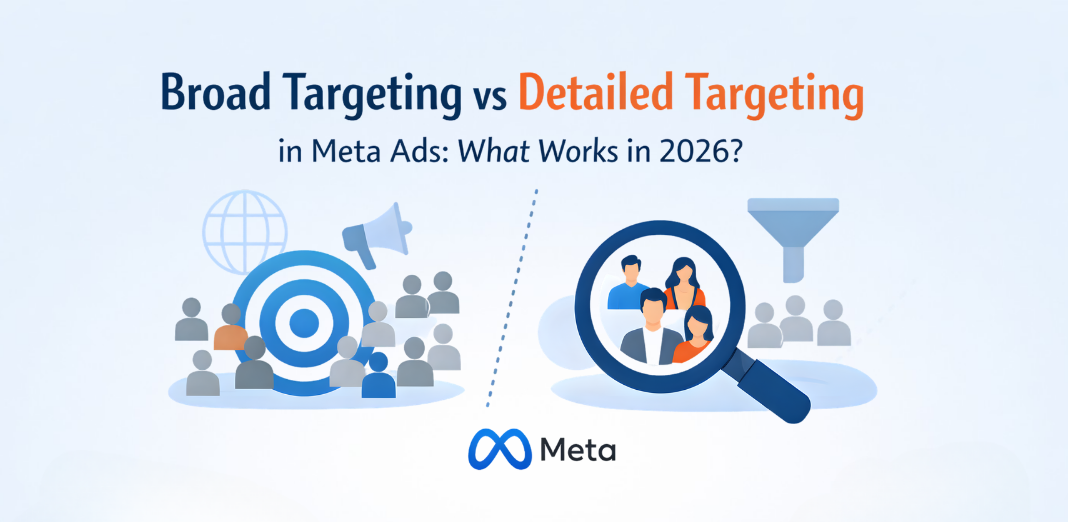

 ×
×

Digital advertising has changed significantly over the past few years, especially on platforms like Meta Platforms. With the introduction of advanced artificial intelligence and machine learning systems, the way advertisers target audiences has evolved dramatically. In the past, marketers relied heavily on detailed targeting options such as interests, demographics, and behaviors to find the right customers. Today, however, the algorithm itself plays a much larger role in identifying potential buyers.
This shift has created an ongoing debate among advertisers: Is broad targeting better than detailed targeting in Meta Ads?
Understanding the differences between these two targeting approaches is essential for running successful campaigns in 2026. Both strategies have their advantages and limitations, and choosing the right one depends on your campaign objectives, budget, and available data.
In this guide, we will explore how broad targeting and detailed targeting work, how Meta’s algorithm has changed the advertising landscape, and which strategy is most effective for modern campaigns.
Audience targeting is one of the most important elements of any advertising campaign. It determines who sees your ads and how effectively your message reaches potential customers.
Traditionally, advertisers carefully selected audiences using specific filters. These filters allowed marketers to narrow down audiences based on demographics, interests, behaviors, job titles, and other characteristics. This approach is known as detailed targeting.
In contrast, broad targeting removes most restrictions and allows the advertising algorithm to find the best users automatically. Instead of defining the audience precisely, advertisers give the algorithm more flexibility to explore different segments.
Both approaches aim to reach the right people, but they rely on very different strategies.
Detailed targeting is the traditional method of audience selection in Meta advertising. It allows advertisers to choose specific characteristics that define their ideal audience.
For example, advertisers can target users based on:
This method gives advertisers a sense of control because they can manually define who should see their ads. For many years, detailed targeting was considered one of the most powerful tools available in Meta Ads.
However, as the platform evolved and privacy regulations changed, the effectiveness of extremely narrow targeting began to decline.
Broad targeting takes a completely different approach. Instead of restricting the audience using detailed filters, advertisers allow the algorithm to decide who should see the ads.
Typically, broad targeting only includes a few basic parameters such as:
Beyond these basic settings, the algorithm is free to explore different audience segments and identify users who are most likely to convert.
The system uses machine learning to analyze user behavior, engagement patterns, and previous conversion data. Based on these signals, it automatically determines which people should see the advertisement.
In recent years, Meta has increasingly encouraged advertisers to adopt broader targeting strategies. This shift is largely driven by advancements in artificial intelligence.
Meta’s algorithm now analyzes thousands of signals to predict user behavior. These signals include browsing patterns, engagement history, content interactions, and purchasing activity. Because the algorithm processes massive amounts of data, it can often identify high-intent users more effectively than manual targeting methods.
Another reason for this shift is privacy regulation. With stricter data privacy rules, platforms have less access to detailed third-party data. As a result, behavior-based machine learning models have become more reliable than manual audience segmentation.
Broad targeting allows the algorithm to use its full analytical power without unnecessary restrictions.
Broad targeting offers several advantages for modern advertising campaigns.
Better Algorithm Learning
When the audience is large, the algorithm has more data to analyze. This allows it to learn faster and identify patterns more efficiently.
Broad audiences often lead to lower advertising costs because the system can find cheaper opportunities to deliver ads.
Campaigns with large audiences can scale more easily because there are more potential users to reach.
As the algorithm collects more data, it continuously refines targeting and improves campaign performance.
Despite the rise of automation, detailed targeting still offers some benefits in certain situations.
Advertisers can define exactly who should see the ads.
Detailed targeting can be effective for businesses targeting specific industries or specialized interests.
Businesses with limited conversion data may initially rely on detailed targeting while the algorithm learns.
However, overly narrow targeting can limit the algorithm’s ability to discover new audiences.
Many advertisers make the mistake of stacking too many interests and behaviors within a single ad set. This creates extremely small audience segments that restrict the algorithm’s learning ability.
Some common problems caused by excessive targeting include:
When audiences become too small, the system struggles to gather enough data to optimize performance.
Broad targeting tends to work best in the following situations:
Because the algorithm has more flexibility, it can explore a wider range of potential customers and discover new opportunities.
Detailed targeting can still be effective in certain scenarios, especially when the audience is very specific.
For example, it may work well for:
In these cases, narrowing the audience can help ensure that ads reach relevant users.
Most experienced advertisers now use a hybrid approach that combines both strategies.
For example, they may start with broader targeting to allow the algorithm to explore potential audiences. After collecting data, they analyze performance and refine targeting if necessary.
Successful campaigns often follow these principles:
When these elements work together, the algorithm can deliver ads to users who are most likely to convert.
In 2026, creative quality has become one of the most important factors influencing campaign performance. Instead of relying solely on targeting settings, advertisers must focus on producing engaging and relevant ad creatives.
The algorithm analyzes how users interact with ads and uses those signals to refine targeting automatically. Ads that generate strong engagement are shown to more people who share similar interests and behaviors.
This means that the effectiveness of your targeting strategy is closely linked to the quality of your creative content.
As artificial intelligence continues to improve, audience targeting will likely become even more automated. Platforms like Meta are investing heavily in predictive algorithms that can identify potential customers without relying on traditional targeting filters.
In the future, advertisers may focus primarily on messaging, creative quality, and conversion optimization while the platform handles audience discovery automatically.
The debate between broad targeting and detailed targeting reflects the larger transformation happening in digital advertising. While detailed targeting once dominated Meta Ads strategies, the rise of machine learning has shifted the balance toward broader audiences and automated optimization.
Broad targeting allows Meta’s algorithm to analyze large amounts of data and discover high-intent users more efficiently. However, detailed targeting can still be valuable in certain niche scenarios.
Ultimately, the most effective strategy in 2026 is not choosing one method exclusively, but understanding when to use each approach. Advertisers who combine strong creatives, reliable data signals, and flexible targeting strategies will be best positioned to achieve consistent success in Meta Ads.

Hello, I’m Arpan, a dedicated social media marketer passionate about crafting engaging content and driving results-driven campaigns. With a keen eye for trends and a strategic approach, I strive to elevate brands and foster meaningful connections with their audience. Let’s collaborate to unlock the full potential of your social media presence!



 Rated 4.99/5 overall
across 100+ reviews
Rated 4.99/5 overall
across 100+ reviews