SEO & Lead Generation
  Google Adwords Management
 Social Media Management
 Ecommerce Marketing
 WordPress & Shopify Services
 Website & App Designing
  Website Speed Optimization
  Website Hosting Services
  Amazon PPC Marketing
  Landing Page Designing
 Logo Designing Services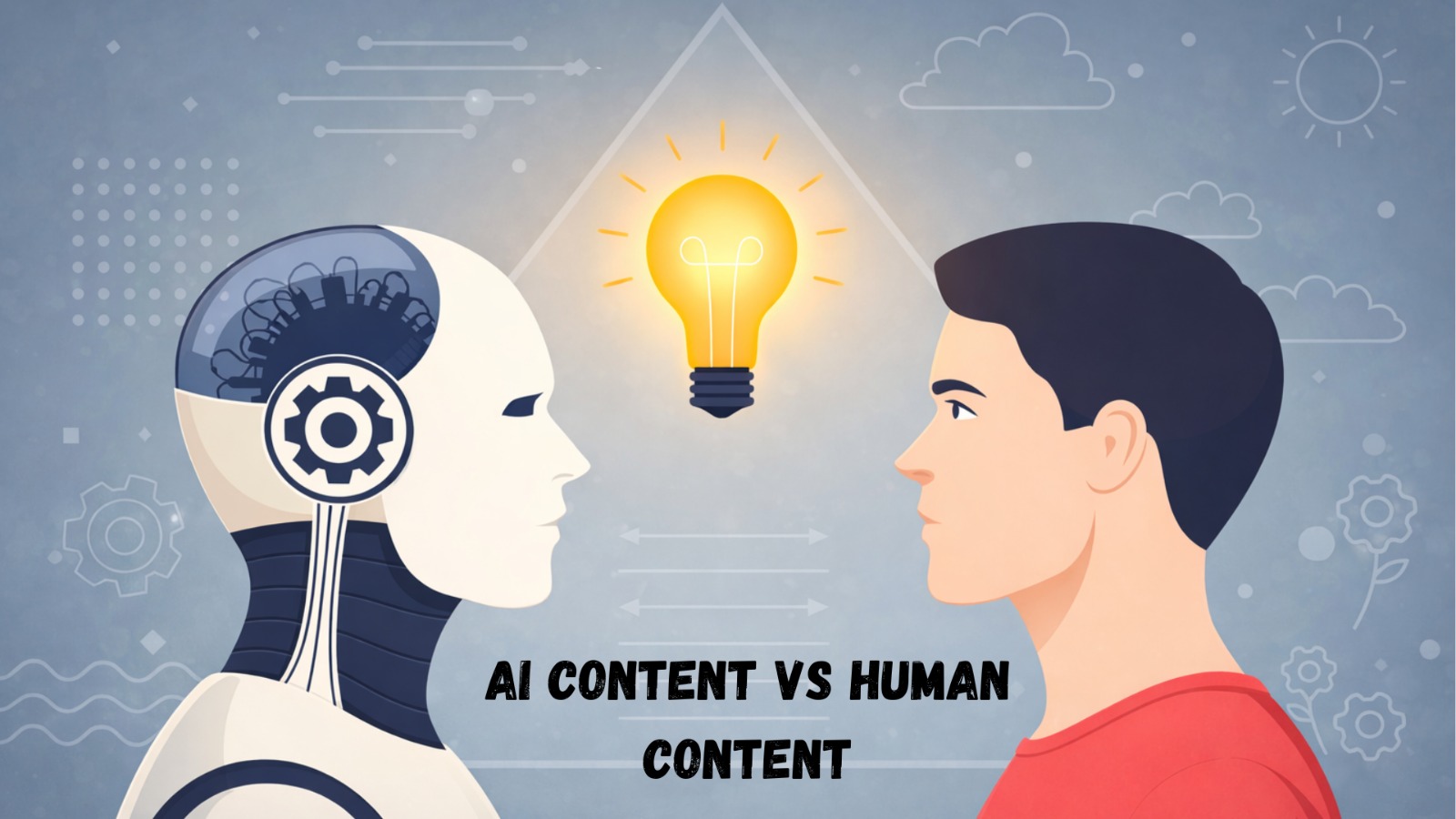

 ×
×

In today’s fast-changing digital world, content is still the backbone of SEO. But how we create that content has changed a lot. The rise of artificial intelligence has sparked a major debate. AI vs human content: which one really wins Google rankings?
Businesses, marketers, and SEO professionals now ask key questions like: Does AI content rank on Google? Is AI–generated content fairly competing with human content?
In this clear guide, we’ll explain what you need to know about AI vs human content SEO. We’ll compare both methods in detail. We’ll help you choose the best plan to boost rankings in 2026.
Over the years, Google’s algorithm has evolved from simple keyword matching to advanced intent-based ranking systems. Today, ranking content depends on:
With AI tools becoming more powerful, content production has become faster—but Google’s standards have also become stricter. This makes the AI content vs human content debate more relevant than ever.
AI content refers to text generated by tools like ChatGPT, Jasper, or other machine learning platforms. These tools analyze massive datasets to produce human-like responses.
This is why the discussion around AI generated content vs human content is not just about speed—but also quality and reliability.
Human content is written by individuals who bring creativity, expertise, and personal experience into the writing process.
Despite these challenges, human-written content remains a strong contender in AI vs human content SEO due to its depth and authenticity.
| Factor | AI Content | Human Content |
|---|---|---|
| Speed | Extremely fast | Slower |
| Creativity | Moderate | High |
| Accuracy | Depends on input | More reliable |
| SEO Optimization | Good with prompts | Excellent with expertise |
| Engagement | Average | High |
| Scalability | High | Limited |
From this comparison, it’s clear that both approaches have strengths—but rankings depend on more than just production speed.
One of the most important questions in SEO today is: does AI content rank on Google?
Yes, AI content can rank—but only if it meets Google’s quality standards.
Google has clearly stated that it does not penalize content based on how it is created. Instead, it evaluates:
This means AI content vs human content is not about the creator—it’s about the outcome.
Google’s Helpful Content System prioritizes content that is:
If your AI content fails to meet these standards, it won’t rank—no matter how optimized it is.
In 2026, the SEO landscape is no longer about choosing sides. Instead, successful strategies combine both approaches.
The most effective approach is blending AI efficiency with human expertise.
This approach ensures your content is both scalable and high-quality.
Many brands, including Kleverish, are already leveraging this hybrid model to achieve better rankings and faster growth.
E-E-A-T is one of the most critical ranking factors in modern SEO.
This gives human content a strong advantage in competitive niches.
At the end of the day, Google measures how users interact with your content.
Human-written content often performs better because it connects with readers on a deeper level.
Many businesses fail in AI vs human content SEO because they misuse AI tools.
These mistakes can harm your rankings instead of improving them.
If you want AI content to perform well, follow these best practices:
Always refine AI-generated drafts to improve clarity and accuracy.
Understand what users are looking for and tailor your content accordingly.
Add case studies, data, and insights to increase credibility.
Use headings, bullet points, and simple language.
Despite the rise of AI, human content continues to outperform in areas like:
These elements are difficult for AI to replicate, making human content more effective for long-term SEO success.
Let’s consider a simple example:
Two blogs target the same keyword.
Blog B is more likely to:
This highlights why AI generated content vs human content is not just about ranking—but also performance.
AI is best suited for:
Human writing is ideal for:
Looking ahead, AI will continue to evolve—but it won’t replace human creativity.
Businesses that adapt to this balance will have a competitive edge.
To succeed in AI vs human content SEO, follow this framework:
Identify high-intent keywords and topics.
Create structured outlines using AI tools.
Combine AI drafts with human expertise.
Optimize for SEO, readability, and engagement.
Update and refresh content regularly.
At Kleverish, this structured approach has helped businesses achieve consistent SEO growth and better rankings.
So, AI vs Human Content — which one wins Google rankings?
The debate around AI vs Human Content is not about replacing one with the other—it’s about using them strategically.
If you want to win in SEO, focus on creating content that truly helps users.
Whether you’re a business owner, marketer, or SEO professional, adopting a hybrid strategy is the smartest move in 2026. Companies like Kleverish are already leading the way by combining AI efficiency with human creativity to achieve top rankings and sustainable growth.

I’m Mansi Gajjar, working at Kleverish Digital Agency as an SEO Executive, where I specialize in improving search rankings, optimizing content, and enhancing overall website performance. With a strong focus on keyword research, on-page SEO, and technical optimization, I aim to drive organic traffic and boost online visibility. I am passionate about implementing effective SEO strategies that deliver measurable results and help brands grow in the digital space.



 Rated 4.99/5 overall
across 100+ reviews
Rated 4.99/5 overall
across 100+ reviews